View My Stats

Saturday, May 19, 2012

Saturday Morning Medieval: Medievalisms and Children’s television programming

This paper was presented on May 11, 2012 at the International Congress of Medieval Studies in Kalamazoo, Michigan for the Society for the Public Understanding of the Middle Ages 10:00 am panel entitled Growing Up with the Middle Ages: The Influences upon Children's Ideas about the Medieval World.

This paper could alternately be called medieval puns, or how many ways can you replace the word night with knight.
.   .   .
In the episode of Spongebob Squarepants, 1999 -, entitled "Dear Vikings," Mr. Krabs has introduced new Viking size drinks to the Krusty Krab. If you buy a Viking size, you get to wear the cardboard Viking helmet Mr. Krabs found in his attic. This prompts Spongebob to ask “What’s a Viking?” Krabs send Spongebob to know-it-all Squidward, who summarily dismisses Spongebob with his fake description:
“The Vikings were a race of scholars and scientists who lived even before Mr. Krabs was born. They are believed to have discovered ketchup, and enjoy dressing up their pets as chunks of masonry on the weekends. Their favourite movies are in black and white, and grown Vikings are known to collect socks, which they display and trade at monthly conventions called Sockengarten.” When Spongebob still has questions Squidward prompts him to write to the Vikings. When they get his letter, the Vikings descend on the Krusty Krab to enlighten Spongebob.
The Vikings tell Spongebob that Vikings like to redecorate, which they demonstrate by destroying things. They say that they also like to appropriate, which they demonstrate by throwing the Krusty Krab cash register on to their ship. Finally, Vikings apparently also like to liberate, which they demonstrate by kidnapping Spongebob and Squidward. Spongebob responds with "I can't believe how much I'm learning." The episode goes on to introduce every Viking as Olaf, except the leader, who is Gordon.
This episode uses the language of education to entertain. It is complete with violence, slapstick and bathroom humour, but it also uses the ubiquitous semiotic system for Vikings, cartoon or otherwise, including dragon ship, beards, axes, rough clothing and the horned Wagnerian helmet.[i] But most interestingly, having the description of Vikings come from supposed Vikings themselves, especially when compared to Squidward’s clearly made-up description, makes the depiction seem authoritative.
Cartoons may be (mostly) intended for children, but they are created by adults.[ii]  When analyzing the text the analyzer must ask is this cartoon intended to entertain or to educate, or what balance is it striking between the two? What is it adults wish to impart to children? Education doesn’t just mean imparting values and teaching lessons, it can also mean adults sharing with children their conception of childhood, or at least child appropriate entertainment.
For example, take the animated cartoon Animaniacs, 1993-1998. This is clearly meant to entertain children, but it is also a tribute to earlier Warner Bros. cartoons - an embodiment of the wish of adults for children to have the same experience and relationship with cartoons that they had. You can market Animaniacs to adults and children because nostalgia is one of its key elements and because slapstick has universal appeal. When marketing an adult friendly version of childhood, it helps to pull forward tales that caught adult imagination when they were children. This is part of the appeal of the romantic and legendary interpretation of the Middle Ages into the twenty first century.
Adults will recognize the ‘Middle Ages’ at a glance. And through repetition of imagery, actions and characters, as well as through parental recognition, children come to that same recognition. Serialized animated cartoons shown on American television share certain signifiers of the European Middle Ages with other mediums. Each individual text uses the signifiers for different purposes, depending on the relationship between the institution producing it, the text and the audience.[iii] However, the signifiers that are used on American television seem to be a rather homogenous whole.[iv] Part of the richness of the cartoons that depict the Middle Ages, or that use these signifiers, is that without having to spend time on explanation, an animator can manipulate one symbol, like a castle, or action, like having characters joust, and in that one element imply a wealth of cultural precedent. The medieval history implicated in the cartoons Americans watch is so different from scholars understanding of the Middle Ages because the history of the interpretation of the Middle Ages is more important than medieval history itself. To create a world that is rich for children, either rich with education or with entertainment, producers of animated cartoons readily mix literature, fantasy and medieval history, drawing upon and manipulating a folk understanding of a mythical world called ‘the European Middle Ages.’  

Reception of an animated Middle Ages

Over the last sixty years North American society has realized, after much debate, it is hard to define how much cartoons influence the thoughts and behaviour of children. A question like ‘how much do television cartoons shape children’s conception of the medieval?’ must ultimately be open-ended. In the media, the image from television cartoons competes and is complemented with that from video games, live action television, film and books.
But the ability of television to impact or mirror societal values, to sell products or to educate has already been thoroughly discussed elsewhere. Producers aiming television at a younger viewing audience learned quickly that cartoons were an efficient means of accessing that audience, as live action series aimed at children did poorly in re-runs and were often ultimately less cost effective.[v] Cartoons consistently brought in ratings for the big network. The network competition for the Saturday Morning Cartoon viewers, not to mention the cultural weight of the phrase Saturday morning cartoons even in an age of ubiquitous access to any kind of television, sheds light on the power of the cartoon with young viewers.[vi] For the television generation animation became “the visual language by which it was assumed children were addressed. The television generation only essentially understood ‘animation’ as ‘the cartoon’ as it had been produced for children and for the children’s demographic.”[vii] Even in the last few decades, with the proliferation of cartoons decidedly not aimed at children, those programs are still more popular amongst younger audiences than live action programs also aimed at adults. Successful adult cartoons create meaning by perverting what we would expect to see in a cartoon aimed at children and playing on the public’s understanding of the cartoon genre.[viii]
That kind of humour is mirrored in Spongebob Squarepants when they pervert an adult medium for communicating with children, education, and use it for entertainment.
So while we can’t determine the exact nature of the impact of cartoons, we can agree that it is part of what forms children’s understandings of the world they live in. It was the importance of cartoons in my life, and even in my choice to study the Middle Ages, that led me to this topic. And I will say that before I started university, my understanding of the Middle Ages looked mostly like these cartoons.

Methodology

What constitutes the corpus of cartoons depicting the European Middle Ages? The Middle Ages itself is a time period spanning a thousand years and an entire continent. In addition, theatrical cartoons of the 1930s and 40s became a staple of television programming from the beginning.[ix] In 1949 the very first made for television cartoon was Crusader Rabbit.[x] 
Since these very first cartoons, medieval or medieval-esque themes have captured the imaginations of children, animators and cartoon producers. So we are looking at a large corpus of cartoons from at least the last seventy years. In the last few decades, the proliferation of channels and ways to watch serialized television cartoons has resulted in an even greater body of work.
So do we count every instance of when someone is referred to as a King, a Prince or a Princess as a medievalism?
In my sample I have included any cartoon which portrays a world that is both feudal and chivalric. Lynn T. Ramey and Tison Pugh in their introduction to Race Class, and Gender in ‘Medieval’ Cinema note that early texts “that labelled the European Middle ages as Feudal, Christian, and chivalric” have been discredited in favour of histories that are more specific to geographic localities and time periods.[xi] Producers and directors of newer media are not unaware of this, but the short hand that has been developed is based on that earlier interpretation, one still taught in many elementary schools as a basis upon which students or teachers can build on if they so choose. So anything that is openly feudal or chivalric, with a system of knights, compounds our understanding or at least portrayal of the Middle Ages.
And, as Chuckie says in Rugrats, 1991-2004, episode Faire Play, set at a Medieval Faire, “if they got castles and horsies and knights then they probably got dragons too.” We see the Middle Ages through the lens of all the intervening centuries, and all the literature, art and folk tales that have cropped up in the mean time. The semiotic system that includes the knight must include the dragon, even though the savvy kid is likely to know that that is fantasy or literature. Unless it was obviously referencing the Asian tradition, like American Dragon: Jake Long, 2005-2007, if the cartoon includes a dragon I include it in the list of ‘medieval’ cartoons. To create this list I started with the 2009 edition of The Encyclopedia of Animated Cartoons, by Jeff Lunberg, which details all the animated cartoons shown on American television stations, including imports from other countries. I looked for cartoons that had a medievalesque setting. Next I went through and tried to pinpoint ones that may have had a ‘medieval’ episode. The sample was limited to depictions of the European Middle Ages. This then raised the question of what to do with depictions of the Middle Eastern Middle Ages because of the obvious overlap with the European Middle Ages. While I could still be swayed either way, I decided not to include those depictions. So while I would include the episode of Disney’s Aladdin, 1994-1995, Dune Quixote, when Aladdin has been convinced that he is a knight that has to slay a dragon, I would not include the whole series.

The result for depictions of the universal Middle Ages is a semiotic system that represents a general ‘medieval’ period, with kings, knights, serfs, damsels, princesses, castles, chivalry, etc., etc., incorporating specific legendary and literary characters, and a separate semiotic system for ‘Vikings’ (never Norse), with few instances of appearances by legendary figures.
No medievalist would divide the whole continent and thousand year period into two groups of people, but a cartoon that includes overt and recognizable medievalisms is very rarely trying to teach us about medieval history.
Here is an instance of the problem with the definition of animated ‘medieval’ cartoons. A few cartoons that are trying to actually show children what the European Middle Ages were really like include educational shows like Time Warp Trio, 2005-2006, TheTime Squad, 2001-2003, Histeria, 1998-2000, or Horrible Histories, 2001-2002. But again, historical education is very rarely the goal of the animated cartoon. Often, they manipulate the images in different ways to create different effects or rich settings, replete with their own built in cultural weight. Take the example of “Knighty Knight Bugs,” the 1955 Warner Bros. cartoon.
Bugs must go to the castle of the Black Knight to bring back the singing sword for the King and the Knights of the Round Table. The cartoon’s use of knights, kings, dragons, shields, castles, armour and a sword reinvents a medieval tale using signifiers that are already familiar to its audience. It is also referring to a story that its audience would understand as medieval, that of King Arthur and the Round Table. Even if the audience wasn’t aware that the origins of the tale are medieval, most audience would recognize the setting of those stories as ‘medieval.’  In fact the tradition surrounding the interpretation of King Arthur and his Knights informs much of the semiotic system. But then what about Disney’sAdventures of the Gummi Bears, 1985-1991?
It also uses knights, kings, dragons, shields, castles, armour and a squire, classic signifiers of the medieval, to create an entirely fantasy world where teddy bear like creatures use their ingenuity, teamwork and magic to help good humans and battle bad ones. The imagery and language used in the two different cartoons is extremely similar. The cartoon’s indebtedness to the media’s interpretations of the Middle Ages is clear. It is hard to count the Bugs Bunny cartoon and not count the Gummi Bears just because it doesn’t purport to represent a real Middle Ages, or a tale from the Middle Ages, because the Bugs Bunny one doesn’t really either. The signifiers are saying these events, while we have made them up, could have been long ago and far away in a world not entirely unlike our own. Ok, so we’ll count Disney’s Adventures of the Gummi Bears, but what about He-Man: Mastersof the Universe, 1983-1985, and She-Ra:Princess of Power, 1985?
At first my instinct told me yes, as did the internet, who when you ask it what are the best medieval cartoons, gives you the top ten medieval/fantasy cartoons. And yet, the grotesque villains, the space age technology, the brightly coloured fantasy worlds, the eighties hair cuts and sexualized cartoon characters suggest nothing particularly medieval. But if we compare He-Man to “Knighty Knight Bugs” there are surprising similarities.

Michael N. Salda, author of the article “Northern Lite: A Brief History of Animated Vikings,” notes that the singing sword in the Bugs Bunny cartoon is derivative of Hal Foster’s Prince Valiant,  about a displaced Nordic prince who arrives at King Arthur’s court and the sword that is only awakened by its true master.[xii] In this case Bugs Bunny is the sword’s master. He-Man is indebted to the same tradition that Prince Valiant and MerryMelodies are drawing on when he draws power from his sword to become He-Man. He-Man’s sword is given to him by the mysterious sorceress of Castle Grayskull, calling up images of the Lady of the Lake and a sword symbolizing someone’s right to rule. He-Man also uses a version of castles, kings, armour and sorcerers. Most medievalists would agree that He-Man makes frequent and regular use of medievalisms, but does it count as a ‘medieval’ cartoon? This is the heart of a debate on neo-medievalisms that is unlikely to be resolved here. From a modernist perspective, I don’t think the creators set out to make something self-referentially medieval, they just drew on adventure stories that appeal to children. From a post-modernist perspective, is it perceived as medieval? All three cartoons draw on a semiotic system that represents the Middle Ages and all three cartoons are contributing to that system. He-Man contributes to our understanding of castles, kings, kingdoms, chivalry and powerful swords, all signifiers that have been used to mean Middle Ages for the last seventy years. So I have included it in my lists of medieval cartoons, but to make my arguments stronger in this paper I use examples that are more evidently and self-referentially medieval.

The animated Middle Ages

          So according to this list, what does the European Middle Ages look like?
          It’s very muddled. But all we have to do is look at the conference program to see that the signifiers of the medieval have become the signifiers of fantasy, not least of all thanks to the work of J.R.R. Tolkien and the ease with which ‘questing’ lends itself to the narrative style of role playing, table top and video games.
Cartoons do nothing to ease the confusion. Deriving their settings from the historical, literary and fantastic Middle Ages that have come before it, animated cartoons often intentionally, and for different purposes, confuse history, literature and fantasy. Take for instance the episode of TeenageMutant Ninja Turtles, 1987-1996, called “Shredder’s New Sword.”
The Turtles are in England visiting a museum. In the museum they see paintings referring to the legend of King Arthur and his Knights of the Round Table. The setting of a museum, implying historical authority, would seemingly confuse the legend with history, but they explain in the context of the cartoon that King Arthur was just a story. Michelangelo exclaims: “You mean none of these knight dudes were real? Total bummer!.” Yet later, Shredder goes in search of the ‘real’ Excalibur, taking it from the ‘real’ graves of Arthur and Gwenevere. Shredder’s use of the sword causes the Middle Ages to be brought into the present. Leonardo says “people seemingly from medieval times have started to appear.” The drama of finding out that a legend is real (in the context of the internal reality of the television show) dictates the actions of the Teenage Mutant Ninja Turtles and the reaction of the audience to the legend become reality. When Arthur is brought to the present, so is his castle and court. The Turtles meet outside of Arthur’s castle, put on knights’ helmets and participate in a tournament with Shredder, Rocksteady and Bebob, complete with colourful tents and jousting equipment. Compare this image to others depicting the Middle Ages. When Leonardo calls what we see on screen ‘medieval’ he is lending authority to this interpretation of the Middle Ages. This authority is corroborated by the repetition of these signifiers in other cartoons and other media. In this episode legend and literature (King Arthur) is blending with history (the Middle Ages) in a world that accepts fantasy (magic swords and dragons) as a given element of the Middle Ages. It doesn’t matter that the whole setting of the show is fantasy (Teenage Mutant Ninja Turtles), because in the internal reality of the show even the Teenage Mutant Ninja Turtles acknowledge that this kind of fantasy is particular to the Middle Ages.
Likewise, in Peabody’s Improbable Histories, 1959-1964, Mr. Peabody and his pet boy Sherman use the Wayback Machine to travel through history.
In the course of their travels they visit Marco Polo, Richard the Lionhearted and Leif Ericson, but they also visit King Arthur and Robin Hood. Yes, it is possible that King Arthur and Robin Hood both had real origins, but Peabody and Sherman are definitely visiting the legends, which is confusing when we imagine that he is only visiting historical figures. Robin Hood is more like the Sir Walter Scott Robin Hood than any likely candidates for the real Robin Hood. The line between literature, legend and history is blurred.
Mr. Peabody and Sherman are not alone. Approximately 75% of the cartoons that have a recognizably medieval theme depict or reinvent aspects of the King Arthur or Robin Hood legends. This includes series where the only part of the legend left are some of the names and a ‘feudal code,’ like Princess Gwenevere and the Jewel Riders, 1995-1996. This shows indebtedness to, and fascination with, these particular tales increases our sense of the Middle Ages as a legendary time. It seems also that depictions of these tales are self perpetuating. The more times King Arthur is portrayed, the more is implied by the reinterpretation of the legend. For instance, the series Blazing Dragons, 1996-1998, is clever because King Allfire and his knights of the square table are all dragons that must defend the kingdom from evil humans. The more we understand cartoons to be for children, the funnier it is when they are perverted for adults. Likewise, the fact that there are hundreds of classic portrayals of King Arthur and his Knights means that much of the humour of Blazing Dragons comes from the perversion of those classic portrayals. And yet, by implication, the series assumes that the signifiers are well known and ingrained in their audience. The pervasiveness of these tales, which overlap with literature, relates back to the idea that children are being brought to know the tales their parents enjoyed in ways adults will think are enjoyable for them. The first King Arthur cartoons would remind adults of the books they had read, and direct reference to this literature is made in the opening of Crusader Rabbit and in the Bugs Bunny cartoon “Knight Mare Hare,” 1955. Newer cartoons relate to the literature and to the earlier cartoons.
Similar signifiers, like castles at the end of winding roads, suits of armour and dragons serve different functions in cartoons depending on the intention of the cartoon or the relationship between the cartoon and the audience. For instance, we can look at the way that the Scooby Doo cartoons, over the years, have used the same symbols to accomplish different things.
The very first Scooby Doo Where are You?, 1969 – 1973, was called “What a Night for a Knight.” When a suit of armour goes missing from the museum the gang learns the legend of the Black Knight, who comes to life when the moon is full. The gang has a long chase scene with a black suit of armour with the red plumage on the top. The medieval here imparts gothic creepiness, and the hanging of shields and banners in the ‘medieval wing’ of the museum gives the legend a sense of history. In this first Scooby Doo series there is always some sort of internal logic used to explain how these American kids stumble upon this medieval imagery. The medieval imparts creepiness but also roots the legends in believability, so we see how the gang might believe there really was such a ghost.
Fast forward to the Scooby Doo Show, 1976-1978. In the episode “Scared a lot in Camelot” the gang visits Shaggy’s uncle, who has brought the Camelot castle stone by stone back from England. So, there is a rational explanation for a castle in the United States, and Velma lends authority to this as an ‘accurate’ depiction of Camelot, calling it a “famous medieval court,” and saying that the inside “looks a lot like Camelot.” The villains dress themselves up as the Black Knight and Merlin. In this series they draw more freely on the same legend (both series make use of the Black Knight). The intent of the medievalisms is still creepiness and rooting the monster in a recognizable legend but the intensity has been increased.  
Skip ahead to the Scooby Doo and Scrappy Doo shorts, 1980 – 1982. In “Sir Scooby and the Black Knight,” no longer looking for a mystery, Shaggy and Scooby stumble on the medieval castle that they mistake for their hotel. The Black Knight appears again, but they mistake him for the hotel manager. In this edition of Scooby Doo it really is the Black Knight and spooky things do actually exist. So instead of grounding it in reality, in this case the medieval signifiers help establish a realm where magic may exist. But the images of the castle have not changed much. Likewise, in the episode “Excalibur Scooby” the castle is back, but this time we have the real Merlin, who needs a dog to complete his spell to get Excalibur back. Merlin may be wearing a different colour, but he looks similar to his earlier incarnation.
TheNew Scooby and Scrappy Doo show, 1983 – 1984, has an episode entitled “Wizards and Warlocks.” This time there is no real danger, except that the same imagery is now linked to a gaming world that Scrappy is a part of, supposedly a tribute to Dungeons and Dragons. The show is reflecting how the medieval imagery is used in the world outside of television, so Merlin and the castle mean the world of fantasy gaming, even though the imagery has not changed.
In the 13 Ghosts of Scooby Doo, 1985, “Scoobra Kadoobra,” the same imagery is used again, but this time for an entirely fantasy world. The villain is the ‘Dark Ages Warlock’ Maldar the Malevolent, who is one of the fantasy creatures that Scooby, Scrappy, Shaggy and Dahpne have to catch. There is not even attempt to root the imagery in the real world, as there was in the early shows when they offered the explanation that they traveled to Europe or that the castle was brought over.
In What’s New Scooby Doo?, 2002 – 2005, in the episode “Large Dragon at Large” we have the same imagery again, but this time it is at a medieval faire. Velma, our source of authority, tells us that “the Glasburgh renaissance fair is the only fair held at a real medieval castle, it’s totally authentic.” This is a ridiculous statement to medievalists, and also to the animators, who juxtapose this statement with a ‘Chaucer’s Churros’ wagon. There is a tongue in cheek jibe here at our current fascination with the concept of ‘authenticity.’ The world of medieval interpretation offers its own setting for mystery. The images, however, are still similar, but there is a self-reflexivity to their use not seen in the earlier series.  
The gang returns to a medieval faire in Scooby Doo, Mystery Incorporated, 2010 – , for “The Grasp of the Gnome.” In one of the cleverest appropriations of medieval imagery, someone is taking out people who have gone to the medieval fair dressed as pirates, instead of knights or damsels, because they are taking away from the historical accuracy of the fair. From my point of view it was a hilarious way to re-appropriate the medieval shorthand that had been used in Scooby Doo cartoons over the last fifty plus years.
I would hesitate to read the cartoons linearly, seeing development of an increasing sophistication in cartoon depictions of the Middle Ages over seventy years, because arguably the Improbable Histories are just as self-referential and self-deprecating as the last example of a Scooby Doo episode. What cartoons do do is represent aspects of the time in which they are produced. And as time progresses each cartoon has more animated precedents to draw upon. With the proliferation of television, and now internet channels, what we have are endless options to draw on, and a proliferation of ways to use the medieval imagery.[xiii]
This was a very general overview of a very large corpus. Much more can be done by looking specifically at many of the texts mentioned here. Modern audiences enjoy lists, so I hope to finish this one to the best of my ability and post it on my blog and then more widely on the internet where it can be added to or subtracted to as the collective will sees fit. Many things can be learned by combining these cartoons in different ways and by making more specific comparisons. Likewise, I have looked at cartoons shown in the United States. It could be interesting to compare this with what has been seen in other countries, or continents to see if there are any differences. Comparisons of the images between the countries that are producing the cartoons could also be very fruitful.
Animated cartoons use assumptions about the Middle Ages, or conventions of the interpretations of the Middle Ages to generate meaning in several different ways. A whole other paper could be written on the way they have been used to construct or deconstruct images of gender. That the shorthand for the Middle Ages was developed using literature, fantasy and folk tales as well as events and artifacts from medieval history means that the signifiers of the Middle Ages are particularly useful in generating literature, fantasy and loveable cartoon scenarios.
          This Fall, 2012, the Cartoon Network is producing Dragons, a series based on the popular Dreamworks animated film How to Train your Dragon, 2010, showing the ongoing legacy of the ‘medieval’ cartoon on American channels.

           What is definitely being passed on on American children’s television is a love of the Middle Ages, and frankly the more that it is mixed with fantasy the more this seems to be true. And I believe, as it did in my case, cartoons are going to continue to have a role in shaping a base or folk understanding of what the Middle Ages were.  
Endnotes


[i] Michael N. Salda, “Northern Lite: A Brief History of Animated Vikings”, in The Vikings on Film: Essays on Depictions of the Nordic Middle Ages, ed. by Kevin J. Harty (Jefferson, North Carolina: McFarland & Company, Inc., 2011) 180.
[ii] David Buckingham, “Introduction: The Child and the Screen”, in Small Screens: Television for Children, ed. by David Buckingham (London: Leicester University Press, 2002) 6.
[iii] Buckingham 11.
[iv] Salda 191.
[v] Paul Wells, “‘Tell me about Your Id, When You Was a Kid, Yah!’: Animation and Children’s Television Culture” in Small Screens: Television for Children. ed. by David Buckingham (London: Leicester University Press, 2002) 65.
[vi] Jeff Lenburg, The Encyclopedia of Animated Cartoons. Third Edition (New York: Checkmark Books, 2009) 11-12.
[vii] Wells 67.
[viii] Helen Nixon, “South Park: Not in Front of the Children” in Small Screens: Television for Children, ed. by David Buckingham (London: Leicester University Press, 2002) 96.
[ix] Lenburg 8.
[x] Lenburg 9.
[xi] Tison Pugh and Lynn T. Ramey, “Introduction: Filming the “Other” Middle Ages”, in Race, Class, and Gender in “Medieval” Cinema. 1-14. Ed. by Lynn T. Ramey and Tison Pugh (New York: Palgrave Macmillan, 2007) 2.
[xii] Salda 180.
[xiii] Julian Sefton-Green, “Cementing the Virtual Relationship: Children’s TV Goes Online”, in Small Screens: Television for Children, ed. by David Buckingham (London: Leicester University Press, 2002) 185.


Bibliography

Big Cartoon Database. www.bcdb.com

Bromley, Helen. “Pandora’s Box or the Box of Delights? Children’s Television and
the Power of Story”. In Small Screens: Television for Children. Ed. by David Buckingham. 208-226. London: Leicester University Press, 2002.

Buckingham, David. “Introduction: The Child and the Screen”. In Small Screens:
Television for Children. Ed. by David Buckingham. 1-14. London: Leicester University Press, 2002.

Buckingham, David. “Child-centred Television? Teletubbies and the Educational
Imperative.” In Small Screens: Television for Children. Ed. by David Buckingham. 38-60. London: Leicester University Press, 2002.

Elliott, B.R.. “8. Guides to the Medieval Worlds”. In Remaking the Middle Ages. 192-
205. Jefferson, North Carolina: McFarland & Company Inc., 2011.

Griffiths, Merris. “Pink Worlds and Blue Worlds: A Portrait of Intimate Polarity”. In
Small Screens: Television for Children. Ed. by David Buckingham. 159-184. London: Leicester University Press, 2002.

Haydock, Nickolas. Movie Medievalism: The Imaginary Middle Ages. Jefferson,
North Carolina: McFarland & Company, Inc., 2008.

Internet Movie Database. www.imdb.com

Lenburg, Jeff. The Encyclopedia of Animated Cartoons. Third Edition. New York:
Checkmark Books, 2009.

Lury, Karen. “A Time and Place for Everything: Children’s Channels”. In Small
Screens: Television for Children. Ed. by David Buckingham. 15-37. London: Leicester University Press, 2002.

Nixon, Helen. “South Park: Not in Front of the Children”. In Small Screens:
Television for Children. Ed. by David Buckingham. 96-119. London: Leicester University Press, 2002.

Pugh, Tison and Lynn T. Ramey. “Introduction: Filming the “Other” Middle Ages”.
In Race, Class, and Gender in “Medieval” Cinema. 1-14. Ed. by Lynn T. Ramey and Tison Pugh. New York: Palgrave Macmillan, 2007.

Salda, Michael N. “Northern Lite: A Brief History of Animated Vikings”. In The
Vikings on Film: Essays on Depictions of the Nordic Middle Ages. Ed. by Kevin J. Harty. 178-192. Jefferson, North Carolina: McFarland & Company, Inc., 2011.

Sefton-Green, Julian. “Cementing the Virtual Relationship: Children’s TV Goes
Online”. In Small Screens: Television for Children. Ed. by David Buckingham. 185-207. London: Leicester University Press, 2002.

Wells, Paul. “‘Tell me about Your Id, When You Was a Kid, Yah!’: Animation and
            Children’s Television Culture”. In Small Screens: Television for Children. Ed. by David   
            Buckingham. 61-95. London: Leicester University Press, 2002.

Sunday, January 29, 2012

I for one am stoked! Tourism and History in Bruce-Grey-Simcoe

Have we snow? I offer three words. 'Wax up dudes.'


So says historical figure John Graves Simcoe in Bruce-Grey-Simcoe's new advertisement campaign, highlighting this area of Ontario's yearly winter wonderland. In the ad on the radio John Graves Simcoe is purportedly raving about the ski conditions in the county that was named after him. If you look at the advertisement campaign on the web, Sir James Bruce, 2nd Earl Charles Grey and Lt. Governor Simcoe all have something to say. An historic photo of them has had ski gear added to it, and the photo speaks. Simcoe's contribution is mentioned above. Bruce says 'Another robust winter is upon us. I for one am stoked!,' and Grey says 'I quite fancy skiing. Especially the Apres."


Many tourist sites are also historic sites. If you think of a location and you are trying to think of what there is to see there, often you think of the old structures and the museums, the sites where specific events happened. No? Just me? Well anyway, for the sites where it is less about seeing and more about doing, like skiing and theme parks and mini putt, history perhaps plays less of a role. However those kind of tourist sites often break out around historic locations, because those places have been interesting to generations of people, like Niagara Falls, or Wasaga Beach. Skiing is a little different though. The hills are not centres where people have been coming and going for centuries, like harbours, or river intersections. But it is the best place for skiing.

I thought the campaign was so interesting. First of all, people are actually going to engage with historical photos of some of Ontario's first founders. These are not people that are well-known. I am familiar with John Graves Simcoe myself, but I even have not done a lot of research about Charles Grey or James Bruce. People are still not going to know who they are, but they are at least going to realize that the county's are named after specific people. This is the most interesting kind of historical education, because it will open the door for certain people to ask more questions, and it brings that tourist approved historical significance to a tourist attraction devoid of that kind of connection or cultural significance.

How effective it will be as an advertisement campaign is harder to judge. I will certainly remember it. And it's quite clever.

Wednesday, January 18, 2012

Dragons, Romanesque and Parliament: Medievalisms at the Legislative Assembly of Ontario as expressions of power

When you stand on the edge of Queen’s Park, the site of the Ontario Legislative Assembly since 1893, you find yourself in what is the most medieval-esque looking area of the city. Medieval-esque is a frightfully vague word, but in its vagueness describes that feeling we get when we get the sense that something is inexplicably medieval. Then again, maybe its not that inexplicable.


A medievalism is a number of things. The way we think about the Middle Ages changes as we change, so even when we study the Medieval period that is a medievalism, because we have to interpret the past through our own eyes and our own version of historical events. However, it is also a medievalism when we use elements of what we think the Middle Ages were to create something new. Likewise, we can also call it a medievalism when elements have continued on from the Middle Ages and we use those elements in our own, modern way. A medievalism is anything where the Middle Ages is being interpreted and transmitted to a more modern audience.

There was no European Middle Ages that occurred geographically here in Toronto, so the medievalism we encounter all around us in the architecture at Queen’s Park is where people use symbols from the Middle Ages to create something new. We’re next to the Gothic structures of U of T, including the awe inspiring Trinity College.


Gothic and Romanesque are two quintessential Northern European Medieval Architectural styles. At Queen's Park the central figure is the massive Romanesque Revival structure. So, built in 1893, why did Canadian Victorian society decide to refer to medieval precedents when constructing their civic structures?


In the early Victorian era medieval and not classical elements are sometimes chosen in Canada to emphasize the Britishness of the cultural influence, which is in opposition to their U.S. neighbours, who want to skip Britain and go back to classical roots (see some of the conclusions reached in the project Mapping Medievalism at the Canadian Frontier). That is in play here, especially in the structures of U of T which are referencing the medieval university traditions at places like Oxford, or Cambridge with their Gothic style. But I don’t think that is the whole explanation. I think in this time, approx. 1870-1885, they use a medieval style of architecture only in part to emphasize Britishness, but mostly they see this as an appropriate symbol for power. It can’t be wholly to separate themselves from the United States because this is a uniquely American form of Romanesque.

Richard A. Waite, British-born Buffalo architect, was given the contract to design the building. This was after as a member of the selection committee he had decided that the Gothic design (the other most recognizable medieval architectural style), proposed by Darling and Curry was unsuitable. The architectural style Richardsonian Romanesque was developed by Henry Hobson Richardson , and it was perfected in New England. When they were designing the civic structures in Toronto they favoured this Richardsonian Romanesque style. E.J. Lennox designed Old City Hall in the Richardsonian Romanesque style, and R.A. Waite chose the style for these, the Ontario Parliament Buildings. These buildings are associated with power. So at that time Richardsonian Romanesque, this Medieval style tempered with American influence, was how Torontonians, as well as New Englanders, expressed power through a structure.

The carvings on the building reflect the Richardsonian Romanesque style. They are largely floral and whimsical, though there are some allegorical. For instance, the building is covered in gargoyles. Some of them look like they should be spouts,which would have been part of their function on Romanesque cathedrals, but is not their function here. They reflect the medieval tradition of the gargoyle, which adorned medieval Romanesque and gothic structures of power. Gargoyles protect the building, and keep evil from it, while at the same time they are whimsical.


The rose window with the Gothic tracing that can be seen on the southwest corner of the central structure of the building was not part of the original plan. Originally it was supposed to house a clock, but during construction they ran out of funds and so the clock was never built. The building opened in 1893 with that area boarded up. They eventually installed this round window. But the carving around the window reflects the original intent to put in a clock and reflects medieval traditions. The signs of the zodiac were placed around the circle as they were in medieval calendars. It shows a conscious effort on the part of the architect R.A. Waite and possibly chief carver William McCormack, to build a Romanesque building while referencing the Romanesque roots and time period.


A Romanesque cathedral might have figures of apostles or saints, figures which are meant to lend power to that location, and give that power spatial representation. Here it is no different. On either side of the building are important political figures who, in a very similar way, give power to the activities that go on here. These figures say that Canadian politics is represented here in this building. What they give to the abstract concept of politics is a spatial representation in this building and a sense of importance, by giving the history of Canadian politics the sense of a past of mythic and monumental proportions.


Waite wanted to use natural light, to compensate for the darkness of the heavy walls. Part of the result was the use of stained glass, a common medieval art form, which look out on to laylights. This is another medievalism that was used as a tool by Waite to increase the sense of grandeur of this building, and is in keeping with dynamic interior space which is part of Richardsonian Romanesque.


Dragons recur throughout the building, inside and out. Here are the dragons at the base of the pillars on the first floor of the east wing. In the Middle Ages the dragon represented the ‘other.’ The knight defeating the dragon was conquering the other - restoring order. In this case the placement of the dragons at the base of the pillars shows, in a similar way, the wild creatures being subdued. Likewise, the tops of those pillars, on the third floor east wing, have dragons adjacent to the ceiling, so that dragons appear on both ends of the pillars. Not to take away the element of whimsy, but in British culture the dragon has special meaning because of St. George, patron saint of England who slew a dragon, and is it is pervasive as a popular symbol in keeping with the medieval style of the building. The moral is: Victorians like dragons! But there are reasons as to why they like dragons.


For the art and architecture a medieval style was chosen, but when we look at the debts and carry-overs in the parliamentary tradition from the Middle Ages we can see why medieval symbols are appropriate to help represent a British Parliament. One carry-over from the Middle Ages is the use of standards to represent people or a group (in this case a nation). Even before the Middle Ages people would give themselves a symbol, often a symbol to rally around during battle. It was in the medieval period, however, that heraldry becomes more formalized. It might be that heraldry, flags, coats of arms, standards, developed at first because people needed to other recognize people on their side during a battle once armour began to obscure who was who, though some historians argue that it was more a fashion and individual vanity that prompted the use of such signs. At first people chose their own symbols, and eventually, when they were associated with nobility, they became hereditary.The origins of Britain's heraldry are very medieval. The British Flag is made up of the cross of St. George (England’s flag),

the cross of St. Andrew (Scotland’s flag)

and the cross of St. Patrick (Irelands’ flag).
These countries are still represented (in the British flag at least) by their respective saints, a tradition that continues on from the Middle Ages. There has also been a perceived continuity to the British monarchy since 1066. In fact, our concept of Britain, the nation, as we understand it took shape during the Middle Ages.

Ontario's Coat of Arms was established in 1909, so it is easy to tell which parts of the building are more recent additions or were reconstructed because the Coat of Arms won't appear on anything original to 1893. The Chief Herald of Canada is the one who, using elements and tropes established from the Middle Ages onwards, is able to create new Coat of Arms for new groups. Even though the Chief Herald is creating something new the Coat of Arms and heraldry is rooted in tradition, so the forms and symbols the Coat of Arms uses are fitted into pre-existing medieval patterns.


It was the signing of the Magna Carta in 1215 which made the King subject to the law and redefined where authority was derived from (that is the basic statement, since as one of the West's favourite documents it is one of the most debated, but for arguments sake lets take this classic view of it). It was signed by King John, but it was King John’s son Henry III who first referred any matter to a ‘parliament,’ meaning he is the first British monarch to also use the word ‘parliament.’ Parliament comes from the French word parlement (remember the French origins of Britain’s rulers since 1066), which is from the Latin parliamentum. Basically it means discussion. He was also the first king to ask his subjects for regular taxation, as the revenues from Crown lands were no longer enough to run the realm. Many of the first members were barons, who were asked for taxation, but eventually they had to ask for taxes directly from representatives of towns, clergy and counties. Length of sessions were based on need, and most often they met in Westminster, but they could meet anywhere. The commons emerged in the 14th century as a group distinct from the barons, but they were usually knights and burgesses. The parliament was also considered the highest court, as people could bring their issues and petitions that they would like to have answered. (For more information see the BBC's History of Parliament).


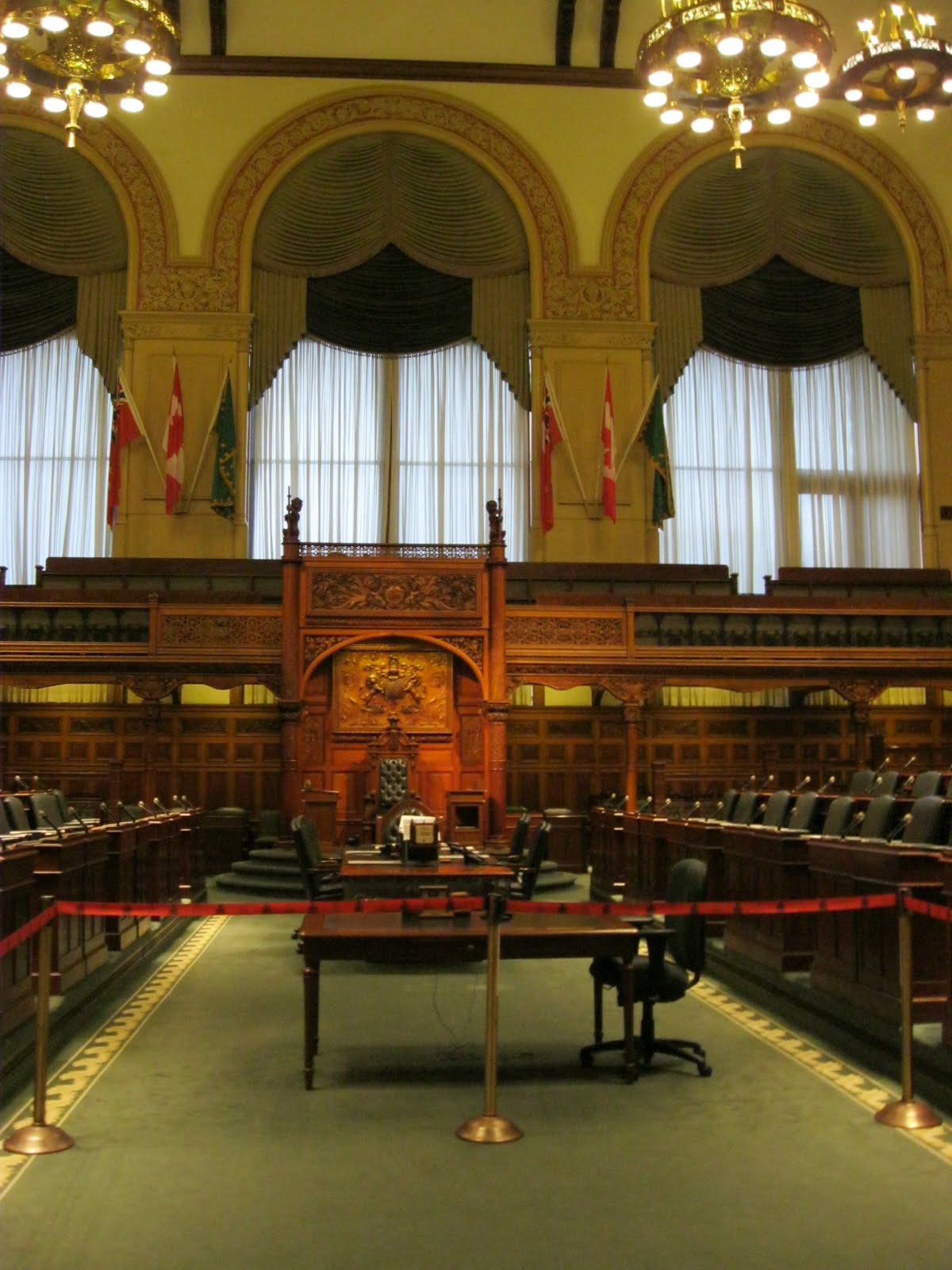
The medieval borrowings in the building and the Legislative Chamber are then really appropriate, because it is from those traditions that our modern form of government has developed. If you look around the Chamber, in addition to inheriting the parliamentary traditions, there is again a conscious use of medieval style, for instance the gargoyles and the figures of whimsy and power.


We again have human faces carved into the Chamber, though unlike the carved political figures on the outside of the building, these ones are tributes to the artists.They are enhancing the whimsy of the space, but they are also people who will forever watch the parliament, so they are not devoid of symbolic meaning.


But there are actual gargoyles around the Chamber, subdued at the base of pillars.

Finally, resting under the Clerk's table is the Legislative Mace, which is placed on the table when the House is in Session to symbolize Ontario's Parliament's authority to make it's own laws. But, as young grade fives are quick to point out, the mace starts out as a medieval weapon, carried into battle by fighting members of the clergy who are not permitted edged weapons. Its use by important people causes it to be used as a symbol of authority.
By the 1200s, the times of the first real parliaments, the mace is being carried by the sergeants-at-arms who protect the king. In time it comes to stand for the authority of the monarch. All British/Commonwealth parliaments still have them. The mace conveys authority, derived from the monarch, to the parliament. Authority is given through it to the speaker, as no one is allowed to pass between the speaker and the mace while the house is in session. Authority is also given to the Members of (Provincial) Parliament, since they are not allowed to have a session without it, and since the mace still points to the Government, and specifically the leader of the government. It’s role as stand in for monarch is also preserved, because when a Vice-Regal representative or the monarch is in the Chamber the mace is, in our case, placed under the table.

In the Chamber there are more examples of heraldry, standards derived from the Middle Ages. For instance, the Royal Coat of Arms behind the Speaker’s Chair, which includes the three lions of England, the harp of Ireland, the unicorn of Scotland on the shield, is derived from the symbols used during the Middle Ages. For instance, the three lions go back to the symbol used by Richard I and which has endured as a symbol of England.

The question is do we still perceive those symbols as something medieval? I do, but I study medieval things. Do most people just see it as tradition, from a non-descript past?


The Legislative Building houses the Ontario Art Collection. Started by founder of the Normal School, Egerton Ryerson, when he went on his ‘Grand Tour’ of Europe. The grand tour was a custom for Victorians, who would go to Europe to collect copies of masterworks. Ryerson brought the copies back to the school museum to be used as educational tools. He brought back paintings as examples of ‘culture.’ So let’s look at what Victorians thought ‘culture’ meant. The subjects of the paintings are classical and biblical, but the original works are renaissance or medieval. Culture was rooted in the past, not the present or the future. It is in this way, through the art and the architecture, that the Victorians brought the medieval into their present. This painting of St. George and the dragon is one of those copies, brought back to educate people who, living in Canada would probably never see the like otherwise. As was mentioned above, St. George, depicted here, who, even when divorced from religion, is symbolic for the whole English nation. St. George is known for slaying a dragon, to save a princess. He is the Victorian ideal of a medieval hero. The frame around the painting has dragons on it, indicating it was made for this painting. But St. George, again, is part of the reason why the dragons are everywhere in the building.

One thing that is striking is that the medievalisms at Queen’s Park, the parliament, Romanesque, dragons, the mace, all incorporate the medieval as symbols of power. The parliament is the decision making body, the grandeur of the Romanesque is seen as appropriate to be associated with sites of power, the mace confers authority on the parliament, and the dragons are both a power that has to be subdued and represent the power of Britain. So the sense that we get that we are surrounded by the medieval is because we are, though we are also well aware that this is an interpretation both by Canadian Victorian society as well as by modern society. The medieval elements we decide to use in our culture tell us a lot about how we view the medieval, but they also show how our distant medieval past influences our present.

Sunday, October 30, 2011

The PhD applicant and the modern Scandinavian language: A Battle of Wills!

One of the major obstacles standing between me and a PhD in a Scandinavian Studies Department is the lack of a modern Scandinavian language.


I don't know if I could have taken it at University while I was there. I am about 98% certain there was no opportunity while I was doing a Medieval Studies degree at Queen's University in Kingston, though I did take Old Norse and Anglo Saxon. If I did have an opportunity it would probably have been during my MA in Norse/Viking Studies in Nottingham. But in my defense, I neither saw anything about it, nor at the time did I realize how much I was going to need one. I actually had the same problem with German, didn't quite realize how necessary it was, but the fix for that has been very easy. At the University of Western Ontario I took German in a class, but if I wanted to do some night school in German here in Toronto somewhere it would be quite easy.

Now, a modern Scandinavian language however, no such luck. No schools in Toronto offer any such thing. Spanish, sure. Greek, no problem. But Swedish? Nah! But to do a PhD in the departments that are most likely to have supervisors for my work, a.k.a. Scandinavian Studies departments, I need it. Right now the schools that I am particularly looking at are the University of Wisconsin-Madison and UCLA Berkeley. This is why it has become a Battle of Wills: my determination to do whatever it takes to get in. When it comes to my PhD, to quote the immortal Wayne's World, 'it will be mine. Oh yes, it will be mine.'

So this is the result of my research:


I have decided to start by learning Swedish. This choice is in part because, as my two specialties are Norse history and Public History eventually I am going to want to look at how movies portray Norse history. Then I should pick the language of the most robust film industry in Scandinavia. But I was on the fence with Swedish and Norwegian. It was the excellent website, and program, of the Uppsala International Summer Session that put me over the edge. Their intensive program, with easy to understand website and application process, put me over the edge. Since making the decision to go there I have also spoken with at least two other people who have gone there, making me feel more confident in this choice. So the plan is to peruse the Swedish grammar over the next six months, so that I do not have to enter the beginner-beginner program. I will probably sign up for Babbel, or try the University of Stockholm's free exercises. I will also probably get a starter grammar book and work through the exercises and vocabulary. Then I will do the course in Uppsala in the summer (hopefully with the aid of a scholarship, because otherwise it may be more of a problem.)

But in my research I came across several options for people trying to study Scandinavian languages in Canada/North America.

Swedish

As I say, this is the language I have chosen, the language of Ingmar Bergman, the place of many runestones. I have chosen to study in Sweden because of the value this would be to admissions boards, and because there is no better way to learn a language than by immersion. Trust me. I studied French since I was 8, but it wasn't until I spent three months with a Francophone family that I could actually speak the language. But you can also learn from a local institution (though, as I have said this is not everywhere available), or you can learn online.

An excellent summary of options for learning Swedish is provided by Study in Sweden. If you choose to study online, for admissions purposes a paid course is better, as there will be evaluation. However, they cost just as much or more than regular university courses. Folkuniversitet looks like it may be the best. It ends up to be about $860(Canadian) a module. Because I want to study in Sweden, this is why I do not wish to pay for other courses.

Norwegian

I was also thinking about studying Norwegian, because I actually hope to do my dissertation on the King's Sagas. More specifically Harold the Hardruler, who was king of, well, Norway. So in many ways it makes sense, particularly for studying the historiography. However, I will still study this, just in an informal setting. The reasons I did not chose Norwegian is because they had no equivalent classes like that offered at Uppsala. The closest I found was the International Summer School at the University of Oslo, which does still seem to offer a lot for those interested in learning Norwegian in Norway. For a summary of how to learn Norwegian a list of options is provided by this Study in Norway website, which is not quite as comprehensive as the Study in Sweden equivalent.

Danish

Danish is an excellent option because, of course, politically speaking it was dominant for so long that many of the historiographical works from throughout Scandinavia are written in Danish. The University of Copenhagen has courses for students, but it is not obvious whether the classes are Danish. A list of other options is provided on the Danish consulate in New York's website. Those are paces that teach Danish in Denmark. Here is another list, from Work in Denmark that give options for learning Danish. I did less research here, as this was less interesting to me, so there may be a more comprehensive website, but as of now I am yet to find it.

Icelandic

It may be erroneous to say so, but from what I understand Icelanders read Old Norse like we read Chaucer. You can kind of read it. You have to have an open mind for interpretation, but it is possible. Therefore this, you would think, would be really useful for a student of Norse and Viking Studies. But be careful, because some of the Departments require a 'mainland' Scandinavian language. The University Centre of the Westfjords offers Icelandic courses, so it is already up on Denmark on having language courses easy to find over the web. Likewise, there are many online options. I am yet to discover a comprehensive list of ways to learn modern Icelandic, like there are for the other countries, but it may yet be out there.

Finnish

Um, there are many good things to say about Finnish, but if you are a student of Norse/Viking Studies you are barking up the wrong tree. The other languages are in a similar linguistic group. Finnish has so many - was it cases, or maybe it was tenses - that it has been called one of the hardest languages to learn. It is closest to Hungarian, as opposed to anything else. And the history is rich, but different. I did no research here. I say go up and read one of the other languages I looked into.

So good luck to all PhD applicants out there, or people interested in Scandinavia. Hopefully your determination too will win out.

Sunday, August 14, 2011

History in the City for the young and the young at heart


So, you've done Centre Island and they've been to Canada's Wonderland. You went to the zoo and they spent the day at the beach. Now what? And why was any sort of museum programming the last thing you thought of? Don't worry, it's not just for the nerdy children amongst us. Often they have so much fun they don't realize they're learning something. Or they don't learn anything, which is fine too, because you might, and they would learn the same nothing at Canada's Wonderland and they'll still have fun.

Studies often show that most of us did not retain the history we do know from what we were taught in school. Many of us remember snippets of movies, books or, mostly, the museums we visited as children. And don't worry if you don't remember what the population of Toronto was when it was founded in 1834, if you remembered that it's only really been around for less than two hundred years, or even if you got the sense that the city was kinda old you did take something away from the experience, whether you meant to or not.

I loved going to museums when I was little (surprise, surprise). Living history museums shaped a large part of the trajectory of my life. I felt like I was stepping into a story. That interested my sister less, but she always liked things like art and making things, and there was always something interesting for everyone to do.

So if you live in the city and are wondering what to do with these last dog days of summer, here are some of the programs aimed at children being put on until the end of August at Toronto Heritage Institutions (which I think includes things like Halls of Fame, Art Galleries and Science Centres, but that is a debate for another day):


Colborne Lodge


Colborne Lodge
has Pay What you Can Sundays. Go and see what you can of the house of High Park founders John and Jemima Howard. And while you're at it, spend the day in the park.
Hours: Tuesday - Sunday noon-5 p.m.
Admission: Adults: $5.71
Seniors (65 +): $2.62
Youth (13-18 yrs.): $2.62
Children (4-12 yrs.): $2.38

Fort York

Fort York has special programming going on all summer. See the cannons fire at 12:30, see the fife and drums in the afternoons, and enjoy the hourly drill demonstrations. This one of the larger living history museums in the city, and certainly represents the oldest time period for Toronto (Fort York was founded when this area was made Upper Canada's capital, around 1796).
Hours: 10 a.m. - 5 p.m.
Admission: Adults: $7.62
Seniors (65 +): $3.81
Youth (13-18 yrs.): $3.81
Children: (4-12 yrs.): $2.86

Gibson House

The Gibson House has a special tour on Sundays, noon to 5 pm, of their 1850s kitchen. This includes a taste of what's cooking and, of course, the hands-on children's activities available in the Discovery Gallery.
Hours: Tuesday - Sunday, noon - 5 p.m.
Admission Adults: $5.48
Seniors (65 +): $3.10
Youth (13-18 yrs.): $3.10
Children (2-12 yrs.): $2.62

Mackenzie House

Mackenzie House, home of Toronto's first mayor has kids crafts on Saturdays and Sundays from noon to 4:30.
Hours: Tuesday - Sunday, noon - 5 p.m.
Admission: Adults: $5.71
Seniors (65 +): $3.81
Youth (13-18 yrs.): 3.81
Children (5-12 yrs.): $3.33
Children (4 and under): Free

Scarborough Museum

The Scarborough Museum has special activities for adults and kids every Saturday and Sunday for their Summer Victorian Extravaganzas. Shows, music, merriment; experience early life in Scarborough.
Hours: Tuesday - Sunday, noon - 5 p.m.
Admission: Donation


Legislative Assembly of Ontario


The Legislative Assembly of Ontario, perhaps not one of the first places we think of when we think of history, but has been there since 1893 and is one of the rare historic buildings that is still in use today. Wednesdays at 10:30 a.m. until the end of the summer there is a scavenger hunt on the grounds, aimed at children between the ages of 6-12. Pre-register or drop in.
Hours: 9:00-5:00
Admission: Free

Royal Ontario Museum

At the Royal Ontario Museum the ongoing exhibit Water includes many hands-on activities and panels aimed at kids. This is in addition to their usual galleries, where the natural history (dinosaurs, bugs, birds and the like) is usually a big hit.
Hours: Saturday - Thursday 10 a.m. - 5:30 p.m., Friday 10 a.m. - 8:30 p.m.
Admission:Adult: $24 + exhibit $31 ($24 + $7)
Senior (65+ years): $21 + exhibit $28 ($21 + $7)
Student (15 to 17 years): $21 + exhibit $28 ($21 + $7)
Child (4 to 14 years): $16 + exhibit $19.50 ($16 + $3.50)
Infant (3 years & under) Free

Bata Shoe Museum

At the Bata Shoe Museum host Weekend Family Fun every weekend, save for when they have other big events. There they can try on shoes, paint a clog or go on a treasure hunt in the galleries. This too is in addition to their usual hands-on exhibits.
Hours:Monday, Tuesday, Wednesday, Friday, Saturday: 10:00am – 5:00pm
Thursday: 10:00am – 8:00pm
Sunday : 12:00pm – 5:00pm
Admission:Adults: $14
Senior citizens (65+): $12
Students (with ID): $8
Children (5-17 years inclusive): $5
children under 5 are free

Gardiner Museum of Ceramic Art

At the Gardiner Museum of Ceramic Art every Sunday is family day. The first Sunday of a month is a movie and a themed scavenger hunt. The second Sunday is themed paper crafts in the lobby. The third Sunday is the guided kids tour and on the fourth Sunday of the month there is typically a performance by storytellers, musicians and other entertainers, though this month the last Sunday will be more crafts in the lobby.
Hours: Monday to Thursday: 10 am – 6 pm
Friday:10 am - 8 pm
Saturday & Sunday: 10 am – 5 pm
Admission:Adults: $12
Seniors: $8
Students: $6
Children: FREE (under 5)


Black Creek Pioneer Village


At Black Creek Pioneer Village, another living history museum, everyday at 2:00 they have a demonstration of something, perhaps butter churning, harness making or something else. They also have daily animal programs, as well as a hands-on history centre. Collect an historic passport and get it stamped at five of the different historic buildings once you complete a task or explore a Country Kids Trail. All these activities are available all summer.
Hours: Week days: 10:00 a.m. - 5:00 p.m.
Weekends: 11:00 a.m. - 5:00 p.m.
Admission: Adult (Age 16-59): $15.00
Child (Age 5-15): $11.00
Infant (Age 4 and under): Free - does not apply for group bookings
Senior (60+): $14.00
Student (16+): $14.00

Ontario Science Centre

At the Ontario Science Centre join them for KidSpark, an activity happening each weekday at 11:00 in July and August. It could be a number of things, including a science demonstration or an art project.
Hours:10 am - 6 pm
Admission:Adult (18-64): $20
Child (4-12): $13
Youth (13-17), Student (with ID), Senior (65+): $16
Infant (3 & under): Free!

Canadian Air and Space Museum

The Canadian Air and Space Museum has a Future Pilots program running on August 20-21. This is a hands on full day activity for teens.
Hours:Wednesday, 10:00am - 8:00pm
Thursday - Saturday, 10:00am - 4:00pm
Sunday, 10:00am - 4:00pm
Holiday Mondays, 10:00am - 4:00pm
Admission: Adults 18+: $ 11.00
Seniors 60+: $ 9.00
Students with school ID: $ 9.00
Military with ID:$ 9.00
Children 5 & under: FREE
Family: 2 adults & 2 Students: $ 27.00


And don't forget the other museums etc. around the city:

Art Gallery of Ontario

The Hockey Hall of Fame
Historic Zion Schoolhouse
Montgomery's Inn
Spadina House: Historic House and Gardens
Todmorden Hills Heritage Site
York Museum
Museum of Contemporary Canadian Art

For more information of upcoming events check out Toronto Museum Events, or the ROM, AGO, Hockey Hall of Fame, Black Creek Pioneer Village etc. websites.

SNL, Pop Culture and Popular Medieval Misconceptions

Read my new blog post on the Society for the Public Understanding of the Middle Ages blog .

In it I muse on how when someone says Viking funeral, the image that is recalled is of a burning ship. No one really cares whether or not this is an accurate tradition, because while the people who are saying are only cursorily meaning to refer to the Middle Ages. What they mean to refer to is the pre-existing cultural image of something going up in flames. It is more interesting to medievalists than anyone else the process of how it got from the historical act of burying their dead to the current twentieth/twenty first century idea of a 'Viking' burial.