I chart my way through my latest degree and try to make sense of pursuing a career in Northern European Medieval and Viking History in Canada. Norse History, Canadian History, History Institutions, Medievalism and Student Life abound.
When you stand on the edge of Queen’s Park, the site of the Ontario Legislative Assembly since 1893, you find yourself in what is the most medieval-esque looking area of the city. Medieval-esque is a frightfully vague word, but in its vagueness describes that feeling we get when we get the sense that something is inexplicably medieval. Then again, maybe its not that inexplicable.
A medievalism is a number of things. The way we think about the Middle Ages changes as we change, so even when we study the Medieval period that is a medievalism, because we have to interpret the past through our own eyes and our own version of historical events. However, it is also a medievalism when we use elements of what we think the Middle Ages were to create something new. Likewise, we can also call it a medievalism when elements have continued on from the Middle Ages and we use those elements in our own, modern way. A medievalism is anything where the Middle Ages is being interpreted and transmitted to a more modern audience.
There was no European Middle Ages that occurred geographically here in Toronto, so the medievalism we encounter all around us in the architecture at Queen’s Park is where people use symbols from the Middle Ages to create something new. We’re next to the Gothic structures of U of T, including the awe inspiring Trinity College.
Gothic and Romanesque are two quintessential Northern European Medieval Architectural styles. At Queen's Park the central figure is the massive Romanesque Revival structure. So, built in 1893, why did Canadian Victorian society decide to refer to medieval precedents when constructing their civic structures?
In the early Victorian era medieval and not classical elements are sometimes chosen in Canada to emphasize the Britishness of the cultural influence, which is in opposition to their U.S. neighbours, who want to skip Britain and go back to classical roots (see some of the conclusions reached in the project Mapping Medievalism at the Canadian Frontier). That is in play here, especially in the structures of U of T which are referencing the medieval university traditions at places like Oxford, or Cambridge with their Gothic style. But I don’t think that is the whole explanation. I think in this time, approx. 1870-1885, they use a medieval style of architecture only in part to emphasize Britishness, but mostly they see this as an appropriate symbol for power. It can’t be wholly to separate themselves from the United States because this is a uniquely American form of Romanesque.
Richard A. Waite, British-born Buffalo architect, was given the contract to design the building. This was after as a member of the selection committee he had decided that the Gothic design (the other most recognizable medieval architectural style), proposed by Darling and Curry was unsuitable. The architectural style Richardsonian Romanesque was developed by Henry Hobson Richardson , and it was perfected in New England. When they were designing the civic structures in Toronto they favoured this Richardsonian Romanesque style. E.J. Lennox designed Old City Hall in the Richardsonian Romanesque style, and R.A. Waite chose the style for these, the Ontario Parliament Buildings. These buildings are associated with power. So at that time Richardsonian Romanesque, this Medieval style tempered with American influence, was how Torontonians, as well as New Englanders, expressed power through a structure.
The carvings on the building reflect the Richardsonian Romanesque style. They are largely floral and whimsical, though there are some allegorical. For instance, the building is covered in gargoyles. Some of them look like they should be spouts,which would have been part of their function on Romanesque cathedrals, but is not their function here. They reflect the medieval tradition of the gargoyle, which adorned medieval Romanesque and gothic structures of power. Gargoyles protect the building, and keep evil from it, while at the same time they are whimsical.
The rose window with the Gothic tracing that can be seen on the southwest corner of the central structure of the building was not part of the original plan. Originally it was supposed to house a clock, but during construction they ran out of funds and so the clock was never built. The building opened in 1893 with that area boarded up. They eventually installed this round window. But the carving around the window reflects the original intent to put in a clock and reflects medieval traditions. The signs of the zodiac were placed around the circle as they were in medieval calendars. It shows a conscious effort on the part of the architect R.A. Waite and possibly chief carver William McCormack, to build a Romanesque building while referencing the Romanesque roots and time period.
A Romanesque cathedral might have figures of apostles or saints, figures which are meant to lend power to that location, and give that power spatial representation. Here it is no different. On either side of the building are important political figures who, in a very similar way, give power to the activities that go on here. These figures say that Canadian politics is represented here in this building. What they give to the abstract concept of politics is a spatial representation in this building and a sense of importance, by giving the history of Canadian politics the sense of a past of mythic and monumental proportions.
Waite wanted to use natural light, to compensate for the darkness of the heavy walls. Part of the result was the use of stained glass, a common medieval art form, which look out on to laylights. This is another medievalism that was used as a tool by Waite to increase the sense of grandeur of this building, and is in keeping with dynamic interior space which is part of Richardsonian Romanesque.
Dragons recur throughout the building, inside and out. Here are the dragons at the base of the pillars on the first floor of the east wing. In the Middle Ages the dragon represented the ‘other.’ The knight defeating the dragon was conquering the other - restoring order. In this case the placement of the dragons at the base of the pillars shows, in a similar way, the wild creatures being subdued. Likewise, the tops of those pillars, on the third floor east wing, have dragons adjacent to the ceiling, so that dragons appear on both ends of the pillars. Not to take away the element of whimsy, but in British culture the dragon has special meaning because of St. George, patron saint of England who slew a dragon, and is it is pervasive as a popular symbol in keeping with the medieval style of the building. The moral is: Victorians like dragons! But there are reasons as to why they like dragons.
For the art and architecture a medieval style was chosen, but when we look at the debts and carry-overs in the parliamentary tradition from the Middle Ages we can see why medieval symbols are appropriate to help represent a British Parliament. One carry-over from the Middle Ages is the use of standards to represent people or a group (in this case a nation). Even before the Middle Ages people would give themselves a symbol, often a symbol to rally around during battle. It was in the medieval period, however, that heraldry becomes more formalized. It might be that heraldry, flags, coats of arms, standards, developed at first because people needed to other recognize people on their side during a battle once armour began to obscure who was who, though some historians argue that it was more a fashion and individual vanity that prompted the use of such signs. At first people chose their own symbols, and eventually, when they were associated with nobility, they became hereditary.The origins of Britain's heraldry are very medieval. The British Flag is made up of the cross of St. George (England’s flag), the cross of St. Andrew (Scotland’s flag) and the cross of St. Patrick (Irelands’ flag). These countries are still represented (in the British flag at least) by their respective saints, a tradition that continues on from the Middle Ages. There has also been a perceived continuity to the British monarchy since 1066. In fact, our concept of Britain, the nation, as we understand it took shape during the Middle Ages.
Ontario's Coat of Arms was established in 1909, so it is easy to tell which parts of the building are more recent additions or were reconstructed because the Coat of Arms won't appear on anything original to 1893. The Chief Herald of Canada is the one who, using elements and tropes established from the Middle Ages onwards, is able to create new Coat of Arms for new groups. Even though the Chief Herald is creating something new the Coat of Arms and heraldry is rooted in tradition, so the forms and symbols the Coat of Arms uses are fitted into pre-existing medieval patterns.
It was the signing of the Magna Carta in 1215 which made the King subject to the law and redefined where authority was derived from (that is the basic statement, since as one of the West's favourite documents it is one of the most debated, but for arguments sake lets take this classic view of it). It was signed by King John, but it was King John’s son Henry III who first referred any matter to a ‘parliament,’ meaning he is the first British monarch to also use the word ‘parliament.’ Parliament comes from the French word parlement (remember the French origins of Britain’s rulers since 1066), which is from the Latin parliamentum. Basically it means discussion. He was also the first king to ask his subjects for regular taxation, as the revenues from Crown lands were no longer enough to run the realm. Many of the first members were barons, who were asked for taxation, but eventually they had to ask for taxes directly from representatives of towns, clergy and counties. Length of sessions were based on need, and most often they met in Westminster, but they could meet anywhere. The commons emerged in the 14th century as a group distinct from the barons, but they were usually knights and burgesses. The parliament was also considered the highest court, as people could bring their issues and petitions that they would like to have answered. (For more information see the BBC's History of Parliament).
The medieval borrowings in the building and the Legislative Chamber are then really appropriate, because it is from those traditions that our modern form of government has developed. If you look around the Chamber, in addition to inheriting the parliamentary traditions, there is again a conscious use of medieval style, for instance the gargoyles and the figures of whimsy and power.
We again have human faces carved into the Chamber, though unlike the carved political figures on the outside of the building, these ones are tributes to the artists.They are enhancing the whimsy of the space, but they are also people who will forever watch the parliament, so they are not devoid of symbolic meaning.
But there are actual gargoyles around the Chamber, subdued at the base of pillars.
Finally, resting under the Clerk's table is the Legislative Mace, which is placed on the table when the House is in Session to symbolize Ontario's Parliament's authority to make it's own laws. But, as young grade fives are quick to point out, the mace starts out as a medieval weapon, carried into battle by fighting members of the clergy who are not permitted edged weapons. Its use by important people causes it to be used as a symbol of authority. By the 1200s, the times of the first real parliaments, the mace is being carried by the sergeants-at-arms who protect the king. In time it comes to stand for the authority of the monarch. All British/Commonwealth parliaments still have them. The mace conveys authority, derived from the monarch, to the parliament. Authority is given through it to the speaker, as no one is allowed to pass between the speaker and the mace while the house is in session. Authority is also given to the Members of (Provincial) Parliament, since they are not allowed to have a session without it, and since the mace still points to the Government, and specifically the leader of the government. It’s role as stand in for monarch is also preserved, because when a Vice-Regal representative or the monarch is in the Chamber the mace is, in our case, placed under the table.
In the Chamber there are more examples of heraldry, standards derived from the Middle Ages. For instance, the Royal Coat of Arms behind the Speaker’s Chair, which includes the three lions of England, the harp of Ireland, the unicorn of Scotland on the shield, is derived from the symbols used during the Middle Ages. For instance, the three lions go back to the symbol used by Richard I and which has endured as a symbol of England.
The question is do we still perceive those symbols as something medieval? I do, but I study medieval things. Do most people just see it as tradition, from a non-descript past?
The Legislative Building houses the Ontario Art Collection. Started by founder of the Normal School, Egerton Ryerson, when he went on his ‘Grand Tour’ of Europe. The grand tour was a custom for Victorians, who would go to Europe to collect copies of masterworks. Ryerson brought the copies back to the school museum to be used as educational tools. He brought back paintings as examples of ‘culture.’ So let’s look at what Victorians thought ‘culture’ meant. The subjects of the paintings are classical and biblical, but the original works are renaissance or medieval. Culture was rooted in the past, not the present or the future. It is in this way, through the art and the architecture, that the Victorians brought the medieval into their present. This painting of St. George and the dragon is one of those copies, brought back to educate people who, living in Canada would probably never see the like otherwise. As was mentioned above, St. George, depicted here, who, even when divorced from religion, is symbolic for the whole English nation. St. George is known for slaying a dragon, to save a princess. He is the Victorian ideal of a medieval hero. The frame around the painting has dragons on it, indicating it was made for this painting. But St. George, again, is part of the reason why the dragons are everywhere in the building.
One thing that is striking is that the medievalisms at Queen’s Park, the parliament, Romanesque, dragons, the mace, all incorporate the medieval as symbols of power. The parliament is the decision making body, the grandeur of the Romanesque is seen as appropriate to be associated with sites of power, the mace confers authority on the parliament, and the dragons are both a power that has to be subdued and represent the power of Britain. So the sense that we get that we are surrounded by the medieval is because we are, though we are also well aware that this is an interpretation both by Canadian Victorian society as well as by modern society. The medieval elements we decide to use in our culture tell us a lot about how we view the medieval, but they also show how our distant medieval past influences our present.
I presented this paper, “Viking” North America: The North American Public’s Understanding of its Norse Heritage at Session 528, 8:30 Sunday Morning in Fetzer 2020 at Western Michigan University for the 2011 International Congress on Medieval Studies at Kalamazoo. The conference was, for me, a great success. As I mention in the paper a lot of these ideas I developed in part while working on the article for Mapping Medievalism at the Canadian Frontier at the University of Western Ontario, and some I developed while interning at L'Anse aux Meadows National Historic Site. In this reproduction all the footnotes are left out, so if you are looking for references please look to the paper I did for Mapping Medievalism at the Canadian Frontier. I have, however, included my bibliography and all my visual aids.
“Viking” North America: The North American Public’s Understanding of Its Norse Heritage
(slide 1)
I would like to start off with a clip. During the 2010 Winter Olympics this ad ran in the province of Ontario nearly once a commercial break. It was part of a larger campaign for Newfoundland and Labrador tourism, though this was the ad they chose to run most frequently. While you watch, take note of the way that North America’s Norse heritage is being presented.
And once again: And so they came, five centuries before Columbus, fearless warriors out to discover a New World, the Vikings. While they left behind their mark, they have long since gone … … so far as we can tell. Newfoundland and Labrador.
This summer, as part of my internship for my public history degree, I worked at L’Anse aux Meadows National Historic Site.
(slide 2: images from summer 2010)
What I can identify as public knowledge about North America’s Norse heritage comes from informal discussions with tourists, from the study of the way that promoters of heritage frame the Norse-North American connection in order to appeal to the public and finally from cursorily studying the historiography. From my research and my experiences I can tell you that this advertising campaign was widely successful. Through talking with people I discovered that a great many of them (I would be so bold to say as one out of three people) had seen the advertisement and had decided to visit L’Anse aux Meadows because of it. For many it was a case of “well we always wanted to come and then we saw that advertisement, you know, with the children.” It was so successful amongst North American audiences that tourism numbers, I can say unofficially, were the highest they had ever been, despite the drop off in American tourism that resulted from the closing gap between the two dollars.
The success of the ad campaign is in part from its stunning images of Newfoundland landscape. However, what brought people up to the northernmost parts of Newfoundland was not just the landscape, since this is stunning, but not remarkably more stunning than other, perhaps more easily accessed, parts of the province. The draw was this emphasis on a medieval European past that genuinely belonged to North Americans. If we listen to the words of this advertisement, in it the province is appealing to everything that makes the ‘Vikings’ popular amongst North American audiences. The advertisement is emphasizing and then reasserting exactly what North Americans think about their own Norse heritage.
(slide three)
I argue that the North American public understands their Norse heritage as part of their origins mythology as a settler/invader nation. This is seen through the continuous coupling of Norse explorers such as Leifr Eiríksson with late medieval European explorers, specifically Christopher Columbus. I would also argue that the North American public’s understanding of the Norse culture can be summed up in everything that is meant by the word Viking and, as in the advertisement, is epitomized by the phrase ‘fearless warriors out to discover a new world.’
(slide 4: image of Christopher Columbus)
Nobody thinks that Christopher Columbus was the first European in North America. Granted, if we are talking about the knowledge of tourists who have made their way to L’Anse aux Meadows, likely if they have made it that far off the beaten path they probably already have an inkling as to why that site is important. However, it has been my experience amongst my friends, family, general adult education classes and pretty much everyone I talk to, that no one still thinks that Christopher Columbus was the first. But he persists as the poster boy for European exploration and colonization in North America and he is the common reference point for the discussion about European arrival to this continent.
(slide 5: images of the manuscripts that contain the Vinland Sagas)
The presence of Vikings, or Norse, in North America was speculated about long before any of the archaeological evidence at either L’Anse aux Meadows or Skraeling Island (just off of Ellesmere Island) was found. The two Icelandic sagas, Grœnlendinga saga and Eiríks saga rauða, have been dubbed the Vinland sagas because of their descriptions of voyages to Helluland, Markland and finally Vinland by the likes of Leifr Eiríksson and Thorfinnr Karlsefni, amongst others. The presence of a real Vinland is corroborated by other textual references.
The level of descriptors in the sagas has caused scholars to find the places mentioned in the sagas in North American localities since the first translations into Latin, and then Danish in the eighteenth and nineteenth centuries. Much scholarship since the nineteenth century has been characterized by this desire to find the real places of the sagas, to find the ‘true’ discoverers of America. This is done by locating the ‘real’ Vinland. Some of these attempts have been more nationalistic than others.
One way that the Norse have been used is to indigenize Europeans to the North American landscape, by at the very least giving the Europeans a longer history on the continent, and by at the most appropriating native arts, culture, or artefacts, and attributing them to the Norse instead of to Native cultures. For example, in 1883 Rasmus B. Anderson wrote a new prologue to his book America Not Discovered by Columbus, in which he said of the creation of the “runes” on the Dighton Rock that had been found in the Taunton River:
(slide 6)
I think they were iron implements, and that they were in the hands of a skilled mechanic—a Norseman worthy of the name. I do not know that my opinion on this question is of any consequence, still I have seen work undoubtedly performed by an aboriginal American with flint and stone tools, but the characters were not nicely edged, as these are. I cannot believe they were made by the lazy Indian of Schoolcraft.
Starting in 1940, Reider T. Sherwin wrote eight volumes on The Viking and the Red Man; The Old Norse Origin of the Algonquin Language. In them he went through the Algonquin vocabulary and showed how each word had an Old Norse origin.
In the search for the 'true' first Europeans it is typical to view the Vikings and Columbus as foils for each other, and to show that only one can be the real 'first.' Take for example, as an extreme, Mary B. Shipley, who, in 1877, wrote one of the more overtly nationalistic works concerning the Norse landings in North America. Her book was entitled The Icelandic Discoverers of America, or, Honor to Whom Honor is Due. In it she stated that the founding of America was one of the greatest achievements in all of world history, and if North America ceased to acknowledge Columbus, but instead acknowledged the Vikings, all the corruption of Catholicism and its most devout followers, the Spanish, would disappear from American culture. In short everything that was good, including the self-determinism and self-government espoused by the Norse, would again be emphasized. That is an extreme, though looking at Vikings in America by Graeme Davis, published in 2009, Davis also saw the “marginalization” of the knowledge of the Icelanders as a plot by Columbus, the papacy, and the Spanish monarchy, and persisted in construing the Norse voyages in terms of the American ideal. He stated that “in the Vikings, America finds its first European settlers. Most fittingly these first European Settlers in America were people searching for what we know today as the American dream of life, liberty and the pursuit of happiness.”
(slide 7: Top left corner; 1840s lecture describing Norsemen as first. Bottom right corner; Mary B. Shipley's book. Centre; Publication accompanying 1992 exhibit at the Canadian museum of Civilization. Bottom left; W.A. Munn. Top right; Helge Ingstad.)
Before the discovery of the archaeological evidence there was a scholarly reaction against taking the sagas as proof of any real place, but that didn’t stop the popular and perhaps amateurish wave of interest in locating the real Vinland. This desire to find the places of the sagas is what lead people like W.A. Munn in 1914, and eventually Helge and Anne Stine Ingstad, to the Straits of Belle Isle to look for evidence of the Norse past. By the end of the 1960s it was agreed that the Norse had been to North America, though we will never all agree as to the locations in the sagas, despite the sometimes fine arguments that are made, because while there are many specific details about geography in the sagas there are too many variables and interpretations possible for those details. Halldór Hermansson’s 1909 Vinland bibliography was ninety pages in length and contained 750 entries. By 1997 Robert Bergersen’s Vinland bibliography, Writings Relating to the Norse in Greenland and America, was 400 closely printed pages. And that was thirteen years ago. I think as well the sheer number of treatises and papers written about this subject, and particularly about the geography of Vinland problematizes this division between scholarly and the public, because I think numbers like this indicate that this subject, possibly because of the traditionally nationalistic overtones, has a wide appeal. In the last thirty years many scholars who work on the Vinland Sagas, and even those who work both with the sagas and with the archaeology, have tried to distance themselves from such nationalistic discussions. In fact many scholars don’t care what personage was first, and see the arrival of these individuals as marking larger trends in technology and in European expansion and colonialism movements from different times. However, if one refers to the corpus of recent publications on Vinland it is evident that about as many analyses were published in 1992, the 500th anniversary of Columbus, as there were in 2000, the supposed 1000th anniversary of Leifr’s settlement. Because scholars approach it from this direction, this nationalistic discourse frames our understanding of the Norse voyages to North America.
And its place in our national mythologies is going to ensure that scholars and the public alike are going to continue to be interested in this particular piece of medieval and North American history.
(slide 8: Leif Eiríksson statue erected in 1887 in Boston)
The knowledge about the Viking arrival, “five centuries before Columbus,” as it states in the advertisement, may have trickled in from scholarly (or less than scholarly) work into the general education. However, this Columbus/Leifr Eiriksson debate has occasionally, throughout the nineteenth and twentieth century, become very public. With the erection of any new public history site, from the Leifr Eiríksson statue erected in Boston 1887 to the recognition of L’Anse aux Meadows as a Norse site in 1960.
(slide 9: Vinland Map, Yale University)
The Vinland map, discovered in the Yale library in 1965, was unveiled a few days before Columbus day and was viewed by some as unseating Columbus once and for all. The map was supposedly from the year 1470, twenty-two years before Columbus’s first voyage. The last time I delivered some of these ideas, someone told me afterwards that one of the people who was really upset by this was Frank Sinatra, who was among those who viewed this as an attack on Italian/American heritage. The map is know largely regarded as a fake, but regardless the existence of a physical map shouldn’t be that different from the oral map that exists in the sagas, though this is a more modern opinion and perhaps a more scholarly one. Inga Dóra Björnsdóttir talks about how the juxtaposition of Leifr and Columbus is politically charged because of the importance of both to the chronology of the North American founding myth, and also because of the importance of having a symbol of unity representative of the Anglo-Saxon race and not of Catholic origin. Leifr Eiriksson day is October 9th. This date was chosen because the ship the Restauration arrived on October 9th, 1825, bringing the first Scandinavian immigrants to the New York harbour from Stavanger, Norway. What is interesting is that Leifr Eiríksson day pre-empts Columbus Day, on 12 October, by three days. The choice of dates is legitimate but also political.
(slide 10: Top left; Runestone museum in Alexandria. Bottom left; Yarmouth Runestone, Nova Scotia. Bottom right; Recreation group at Norstead in L'Anse aux Meadows. Top right; L'Anse aux Meadows.)
So the public understands this Columbus/Viking dichotomy. We can look then at the way that heritage/tourism industries appeal to this sense of ‘who was first.’ There are several locations in North America that celebrate North America’s Norse heritage. L’Anse aux Meadows has the most legitimacy because of the presence of the archaeological site. The arctic sites are important to heritage, but the lack of the tourist gaze in that area of the world has resulted in very little commemoration. Therefore, in that area no one is concerned about marketing the area’s medieval heritage in terms of the public’s interests and understanding. Some heritage/tourism sites gain a form of legitimacy by claiming to be an interpretation of what could have been or are museums to the culture as opposed to any specific events, like Norstead, the living history museum across from the official site at L’Anse aux Meadows. Some institutions house artefacts that could be Norse, and might not be, like the runestone at the Yarmouth museum, and allow visitors to make up their own mind. What is really interesting is that the meagre set of evidence has resulted in the proliferation of interpretation sites all the way from Minnesota and Ohio to the edge of Newfoundland. This helps to represent the place that this history holds in the minds of the public, in that there is an audience for this wide range of sites.
(slide 11: sign erected by tourism association on road into St. Anthony/ L'Anse aux Meadows)
One interesting thing I came across during my time at L’Anse aux Meadows was this sign, which has been placed by the Northern Peninsula tourism association along the road into St. Anthony and L’Anse aux Meadows. The interesting story that I heard, as it was told to me, is that the consultant had suggested putting a sign there that said ‘Is this Vinland?’ Instead, the tourism association were the ones who decided that now was no longer the time to question. The sixties is when they questioned, now was when they marketed this very real and very tangible connection to the medieval.
(slide 12: signs marking the major route, the Viking trail, through the northern peninsula)
The whole landscape of the Northern Peninsula now reflects this rebranding and this reinterpreting in terms of the connection to the medieval, because this is a part of history that continues to resonate with people.
Whether Norse or Viking is a more appropriate term to describe the culture of culture of 750-1100 CE Scandinavia is an ongoing debate. Viking is a word that conjures up images of brutal raiders and pirates, as well it should as the Old Norse word vikingr and the Anglo Saxon wicingas refers to basically pirates. Viking is a reflection of Victorian imaginations of romantic brutality. This is not to deny the brutal aspect of the culture, but it is only one aspect of this largely agrarian and mercantile society. Here a division between scholars and public is a bit more defined, as scholars like the word Norse better. The public has never heard this word. L’Anse aux Meadows archaeologist Birgitta Wallace has this to say about the continuing debate between the use of the two words.
(slide 13)
Historians have substituted the words “Viking” and “Vikings” with Norse, which is a more comprehensive term, corresponding to the Scandinavian norroen, and referring to all Scandinavians of the Viking and Medieval periods. Historians have tended to insist on this more correct term, but references to “Vikings” and “Viking Age” has [sic] become so successful in the promotion of heritage and tourism that most historians now accept these terms.
Like many nineteenth century romantic medievalisms, the term Viking and all that it evokes has proved so durable a concept, that it is counter productive to disregard this word as a term for that culture. Without it we discard the basic building block for the public’s understanding of this culture. The word Viking carries basic images with it. Likewise, the use of certain symbols in pop culture, for better or worse, can stand in for a description of Vikings. One has only to give a character a horned helmet for the audience to understand that he is meant to be a Viking.
(slide 14: Top; How to Train your Dragon. Bottom left; Hagar the Horrible. Bottom right; Commercial for Capital One. Bottom centre; Commercial for Volkswagen minis.)
I would say that films, like How to Train your Dragon, and popular culture, credit card commercials, continue to use this image not because they are ignorant and because they don’t know any better per se, but because they can skip a lot of exposition about who one is trying to depict by just giving them the helmet. So much is implied by these images because it is assumed that the public understands and has seen these images before. They draw on the public understanding and continue to foster it, misconceptions and all.
(slide 15: images from L'anse aux meadows summer 2010)
Telling visitors that there was no evidence of horned helmets, and that the concept had come instead from Wagnerian opera, was one of the most interesting interpretation tools at the disposal of the L’Anse aux Meadows staff, because in some ways it is challenging the one thing that most of the public believes they know about the Vikings.
(slide 16)
In conclusion, the North American public understands this not as Norse, but as Viking heritage. The culture is known for its violence and its raiding; for being one of ‘fearless warriors.’ And yet, it also gives it a place of primacy in the history of North America. It will continue to be a favourite subject amongst people who write popular histories, because of the emotional and romantic place accorded to these events and to the arrival of these so-called ‘first’ Europeans. Talking with tourists I was able to confirm that the way that the Norse heritage in North America is marketed by institutions like Newfoundland and Labrador tourism both reflects and in turn is further constructing the way the heritage is understood by the North American public.
(slide 17: images from the Mapping Medievalism at the Canadian Frontier project)
Many of these ideas are versions of ones that I put forth in my paper “Putting the Vikings on the Canadian Map,” which was published as part of the UWO project and exhibition Mapping Medievalism at the Canadian Frontier. A copy of this version of my paper I am going to put up on my blog, but for a more in depth discussion look to this original paper, published by Museum London.
Thank you
(slide 18)
Bibliography
Anderson, J. R. L. Vinland Voyage. London: Eyre & Spottiswoode, 1967.
Anderson, Rasmus B. America not Discovered by Columbus. 3 ed. Chicago: S.C. Griggs and Company, 1883.
Arneborg, Jette. “Greenland, the Starting-Point for the Voyages to North America.” In Viking Voyages to North America, edited by Birthe L. Clausen. Denmark: Kannike Tryk A/S, 1993, 13-21.
Baitsholts, Kenneth. “Humour, Irony, and Insight: The first European Accounts of Native North Americans.” In Vinland Revisited: The Norse World at the Turn of the First Millennium, edited by Shannon Lewis-Simpson. St John’s: Historic Sites Association of Newfoundland and Labrador, 2003, 365-375.
Barrett, James H. “Introduction.” In Contact, Continuity and Collapse the Norse Colonization of the North Atlantic, Edited by James H. Barrett. Belgium : Brepols, 2003, 1-7.
Barnes, Geraldine. Viking America: The First Millennium. Cambridge: D. S. Brewer, 2001.
Björndóttir, Inga Dóra. “Leifr Eiríksson versus Christopher Columbus: The Use of Leifr Eiríksson in American Political and Cultural Discourse.” In Approaches to Vinland: A Conference on the Written and Archaeological Sources for the Norse Settlements in the North Atlantic, edited by Andrew Wawn & Þórunn Sigurđardóttir. Reykjavík: Sigurður Nordal Institute, 2001, 220-226.
Brown, George Mackay. Vinland. London: J. Murray, 1992.
Curran, James W. Here was Vinland; The Great Lakes Region of America. Sault Ste. Marie: The Sault Daily Star, 1939.
Davis, A. Antiquities of America: The First Inhabitants of Central America, and the Discovery of New-England by the Northmen, Five Hundred Years before Columbus with Important Additions, 16 ed. Boston: Button and Wentworth’s Print, 1846.
Davis, Graeme. Vikings in America. Edinburgh: Birlinn Ltd., 2009.
Eckhoff, Nicolay. “A Norseman’s Encounter in Vinland, a Millennium Later.” In Vinland Revisited: The Norse World at the Turn of the First Millennium, edited by Shannon Lewis-Simpson. St John’s: Historic Sites Association of Newfoundland and Labrador, 2003, 189-192.
“Eirik the Red’s Saga.” The Sagas of Icelanders, Edited by Keneva Kunz. USA: Penguin Books, 2000, 653-674.
Emery, Elizabeth. “Medievalism and the Middle Ages.” In Defining Medievalism. Studies in Medievalism 17, Edited by Karl Fugelso. London: Boydell & Brewer, 2009, 77-86.
Enterline, James Robert, ed. Erikson, Eskimos and Columbus: Medieval European Knowledge of America. Baltimore: John Hopkins University Press, 2002.
Fardy, B.D.. Leifsburdir: The Vikings in Newfoundland. St. John’s: Harry Cuff Publications, 1993.
Frydendahl, Knud. “The Summer Climate in the North Atlantic About the Year 1000.” In Viking Voyages to North America, edited by Birthe L. Clausen. Denmark: Kannike Tryk A/S, 1993, 90-94.
Great Unsolved Mysteries in Canadian History. “Where is Vinland?” Canadian Heritage & University of Victoria. http://www.canadianmysteries.ca/sites/vinland/home/indexen.html.
Goldie, Terry. Fear and Temptation: The Image of the Indigene in Canadian, Australian, and New Zealand Literatures. Kingston: McGill-Queen’s University Press, 1989.
Halldórsson, Ólafur. “The Vinland Sagas.” In Approaches to Vinland: A Conference on the Written and Archaeological Sources for the Norse Settlements in the North Atlantic, edited by Wawn Andrew & Þórunn Sigurđardóttir. Reykjavík: Sigurður Nordal Institute, 2001, 39-51.
Hansen, Keld. “True or False – Fake Traces of the Vikings in America.” In Viking Voyages to North America, Edited by Birthe L. Clausen. Denmark: Kannike Tryk A/S, 1993, 83-91.
Hermannsson, Halldór. The Vinland Sagas, Islandica. New York: Kraus Reprint, 1966.
Howley, Right Reverend Bishop. Vinland Vindicated. Toronto: Copp, Clark, 1898.
Ingstad, Helge. The Norse Discovery of America: Volume II, The Historical Background and the Evidence of the Norse Settlement Discovered in Newfoundland. Norway: Norwegian University Press, 1985.
Jakobsson, Sverrir. “‘Black Men and Malignant-Looking’: The Place of the Indigenous Peoples of North America in the Icelandic World View.” In Approaches to Vinland: A Conference on the Written and Archaeological Sources for the Norse Settlements in the North Atlantic, edited by Andrew Wawn & Þórunn Sigurđardóttir. Reykjavík: Sigurður Nordal Institute, 2001, 88-104.
Johnson, Brian. “Viking Graves Revisited: Pre-Colonial Primitivism in Farley Mowat’s Northern Gothic.” In Unsettled Remains: Canadian Literature and the Postcolonial Gothic, edited by Cynthia Sugars and Gerry Turcotte. Waterloo: Wilfred Laurier Press, 2009.
Kunz, Keneva. “The Vinland Sagas.” The Sagas of Icelanders. USA: Penguin Books, 2000, 626-635.
Landsverk, O.G. Runic Records of the Norsemen in America. USA: Erik J. Friis, 1974.
Larsson, Mats G. “The Vinland Sagas and the Actual Characteristics of Eastern Canada—Some Comparisons with Special Attention to the Accounts of the Later Explorers.” In Vinland Revisited: The Norse World at the Turn of the First Millennium, edited by Shannon Lewis-Simpson. St John’s: Historic Sites Association of Newfoundland and Labrador, 2003, 391-398.
Lewis, Archibald R. “The Closing of the Medieval Frontier, 1250-1350.” Speculum (1958): 475-483.
Lewis-Simpson, Shannon. “Introduction: Approaches and Arguments.” In Vinland Revisited: The Norse World at the Turn of the First Millennium, edited by Shannon Lewis-Simpson. St John’s: Historic Sites Association of Newfoundland and Labrador, 2003, 21-25.
Magnusson, Magnus. “Vinland: The Ultimate Outpost.” In Vinland Revisited: The Norse World at the Turn of the First Millennium, edited by Shannon Lewis-Simpson. St John’s: Historic Sites Association of Newfoundland and Labrador, 2003, 83-96.
Markewitz, Darrell. “The ‘Viking Encampment’ at L’Anse aux Meadows National Historic Site of Canada: Presenting the Past.” In Vinland Revisited: The Norse World at the Turn of the First Millennium, edited by Shannon Lewis-SimpsonSt John’s: Historic Sites Association of Newfoundland and Labrador, 2003, 193-202.
McAleese, Kevin. “L’Anse aux Meadows: Rediscovered and Remade.” In Vinland Revisited: The Norse World at the Turn of the First Millennium, edited by Shannon Lewis-Simpson. St John’s: Historic Sites Association of Newfoundland and Labrador, 2003, 181-187.
-----. “Skrælingar Abroad—Skrælingar at Home?” In Vinland Revisited: The Norse World at the Turn of the First Millennium, Edited by Shannon Lewis-Simpson. St John’s: Historic Sites Association of Newfoundland and Labrador, 2003, 353-364.
McGhee, Robert. Canada Rediscovered. Ottawa: Canadian Museum of Civilization, 1991.
-----. “Epilogue: Was there Continuity from Norse to Post-Medieval Explorations of the New World.” In Contact, Continuity and Collapse the Norse Colonization of the North Atlantic, edited by James H. Barrett. Belgium: Brepols, 2003, 239-248.
-----. “The Skraelings of Vinland.” Viking Voyages to North America. Edited by Birthe L. Clausen. Denmark: Kannike Tryk A/S, 1993, 43-53.
McKay, Ian. “History and the Tourist Gaze: The Politics of Commemoration in Nova Scotia, 1935-1964,” Acadiensis (Spring 1993): 102-138.
Meldgaard, Jørgen. “Preface: Vinland Research 1832-1992.” In Viking Voyages to North America, edited by Birthe L. Clausen. Denmark: Kannike Tryk A/S,1993, 5-12.
Mjelde, M.M. “The Norse Discoveries of America: The Eykarstaðr problem”. Saga-Book 10 (1922): 57-68.
Mowat, Farley. Westviking: The Ancient Norse in Greenland and North America. Toronto: McClelland and Stewart Ltd., 1965.
Munn, W.A.. Wineland Voyages: Location of Helluland, Markland & Vinland. St John's: Dicks and Company Limited, 1992.
Pohl, Frederick J.. The Vikings on Cape Cod. Pictou, Nova Scotia: Pictou Advocate Press, 1957.
Pope, Peter. “Did the Vikings Reach North America without Discovering It? The Greenland Norse and Zuan Caboto in the Strait of Belle Isle.” In Vinland Revisited: The Norse World at the Turn of the First Millennium, edited by Shannon Lewis-Simpson. St John’s: Historic Sites Association of Newfoundland and Labrador, 2003, 341-352.
Power, L.G. The Whereabouts of Vinland. Halifax, N.S., 1892.
Rode, Eva. “The Vinland Sagas and their Manuscripts.” In Viking Voyages to North America, edited by Birthe L. Clausen. Denmark: Kannike Tryk A/S, 1993, 22-29.
Roesdahl, Else. “Walrus Ivory and Other Northern Luxuries: Their Importance for Norse Voyages and Settlements in Greenland and America.” In Vinland Revisited: The Norse World at the Turn of the First Millennium, Edited by Shannon Lewis-Simpson. St John’s: Historic Sites Association of Newfoundland and Labrador, 2003, 145-152.
Rowe Elizabeth Ashman. The Development of Flateyjarbók: Iceland and the Norwegian Dynastic Crisis of 1389. Odense: University Press of Southern Denmark, 2005.
Ruth, Roy Herbert. The Vinland Voyages: The Icelanders Discover America and Write the First Canadian History. Winnipeg: Columbia, 1965.
Schledermann, Peter. “Inuit-Norse Contact in the Smith Sound Region.” Contact, Continuity and Collapse the Norse Colonization of the North Atlantic. ed. James H. Barrett. Belgium : Brepols, 2003, 183-205.
-----. “Norsemen in the High Arctic?” In Viking Voyages to North America, edited by Birthe L. Clausen. Denmark: Kannike Tryk A/S, 1993, 54-66.
Seaver, Kristen. Maps, Myths and Men: the Story of the Vinland Map. California: Stanford University Press, 2004.
-----. “The ‘Vinland Map’: Faith, Facts, and Fables.” In Vinland Revisited: The Norse World at the Turn of the First Millennium, edited by Shannon Lewis-Simpson. St John’s: Historic Sites Association of Newfoundland and Labrador, 2003, 443-456.
Shendock, George M. “A Core Condensation of My Ideas Concerning the Locations of Sites Mentioned in the Voyages of Leifr Eiriksson, Þorvaldr Eiriksson and Þorfinnr Karlsefni.” In Vinland Revisited: The Norse World at the Turn of the First Millennium, edited by Shannon Lewis-Simpson. St John’s: Historic Sites Association of Newfoundland and Labrador, 2003, 399-410.
Sherwin, Reider T. The Viking and the Red Man; The Old Norse Origin of the Algonquin Language, 8 vols. New York: Funk & Wagnalls company, 1940-1970.
Shipley, Marie A. Brown. The Icelandic Discoverers of America, or, Honor to Whom Honor is Due. New York: John B. Alden, 1887.
-----. The Icelandic Discoverers of America, or, Honor to Whom Honor is Due. 2 ed. New York: John B. Alden, 1890.
Simmons, Clare A. “Introduction.” Medievalism and the Quest for the ‘Real’ Middle Ages. ed. Clare A. Simmons. Portland: Frank Cass and CO., 2001.
-----. “Medievalism: Its Linguistic History of Nineteenth Century Britain.” In Defining Medievalism. Studies in Medievalism 17, edited by Karl Fugelso. London: Boydell & Brewer, 2009, 21-35.
Vilhjálmsson, Þorsteinn. “Navigation and Vinland.” In Approaches to Vinland: A Conference on the Written and Archaeological Sources for the Norse Settlements in the North Atlantic, edited by Wawn Andrew & Þórunn Sigurđardóttir. Reykjavík: Sigurður Nordal Institute, 2001, 107-181.
“The Saga of the Greenlanders.” In The Sagas of Icelanders, edited by Keneva Kunz. USA: Penguin Books, 2000, 636-652.
Thirslund, Søren & C. L. Vebæk. The Viking Compass Guided Norsemen First to North America. Copenhagen: The Authors and the Danish Bodil Pedersen Foundation, 1993.
Thórdarson, Matthias. The Vinland Voyages. American Geographical Society Research Series 18. Translated by Thorstina Jackson Walters. New York: American Geographical Society, 1930.
Torfason, Thormod. The History of Ancient Vinland. Translated by Charles G. Herbermann. New York : J.G. Shea, 1891.
Vinner, Max. “The Mysterious Vinland Map (“The Map that Spoiled Columbus Day”).” In Viking Voyages to North America, edited by Birthe L. Clausen. Denmark: Kannike Tryk A/S, 1993, 77-82.
Vinner, Max. “Vinland the Good- or the Lost.” In Viking Voyages to North America, edited by Birthe L. Clausen. Denmark: Kannike Tryk A/S, 1993, 67-76.
Wahlgren, Erik. The Kensington Stone: A Mystery Solved. Madison: University of Wisconsin Press, 1958.
-----. “Fact and Fancy in the Vinland Sagas.” In Old Norse Literature and Mythology, edited by Edgar C. Polomé, 19-80. Texas: University of Texas Press, 1969.
Wallace, Birgitta Linderoth. “Vinland and the Death of Þorvaldr.” In Vinland Revisited: The Norse World at the Turn of the First Millennium, edited by Shannon Lewis-Simpson. St John’s: Historic Sites Association of Newfoundland and Labrador, 2003, 377-390.
-----. Westward Vikings: The Saga of L’Anse aux Meadows. St John’s: Historic Sites Association of Newfoundland and Labrador, 2006.
Washburn, Wilcomb E. Proceedings of the Vinland Map Conference. Studies in the History of Discoveries. Chicago: University of Chicago Press, 1971.
Wawn, Andrew & Þórunn Sigurđardóttir. “Introduction.” In Approaches to Vinland: A Conference on the Written and Archaeological Sources for the Norse Settlements in the North Atlantic, edited by Andrew Wawn & Þórunn Sigurđardóttir, 9-14. Reykjavík: Sigurður Nordal Institute, 2001.
Wawn, Andrew. “Victorian Vinland.” In Approaches to Vinland: A Conference on the Written and Archaeological Sources for the Norse Settlements in the North Atlantic, edited by Wawn Andrew & Þórunn Sigurđardóttir. Reykjavík: Sigurður Nordal Institute, 2001, 191-206.
Wilson, Sir Daniel. The Vinland of the Northmen. Ottawa: Transactions of the Royal Society of Canada, Section II, 1890.
Wolf, Kirsten. “The Recovery of Vinland in Western Icelandic Literature.” In Approaches to Vinland: A Conference on the Written and Archaeological Sources for the Norse Settlements in the North Atlantic, edited by Andrew Wawn & Þórunn Sigurđardóttir. Reykjavík: Sigurður Nordal Institute, 2001, 207-219.
Woxen, Trond. “Afterword: Where’s Vinland?” In Vinland Revisited: The Norse World at the Turn of the First Millennium, edited by Shannon Lewis-Simpson. St John’s: Historic Sites Association of Newfoundland and Labrador, 2003, 457-458.
It is not a plight reserved only for Public Historians, though I was attempted to make that statement in the title. Most of us ambitious come to this point, at the intersection of rejection, anticipation and triumph, where so much is happening so very quickly that you are missing all the action while you are busy waiting for your life to start.
For this Public Historian/Medievalist, confident in her own abilities yet no stranger to rejection, I find myself poised on the edge of such a moment.
I graduated from the Public History program at Western in October. Technically the program finished in August, but I was able to prolong my internship at L'Anse aux Meadows into October. Now, like many trained professionals I want a job in the field I am trained for, though my main criteria for employment is that it is challenging and that I enjoy it.
When we met for graduation in October not one of us from the graduating class yet had a job. Not surprising. Nor is it surprising that some of us have found work in the field, some of us have found other kinds of work, some of us are still looking and some are now doing more school.
This week I am expecting to hear back from three jobs. One I interviewed for in November. They said the decision would take them a few weeks. Ha! Fair enough, as long as you judge weeks in 'government time.' One I interviewed for last week seems really interesting and would also be in my field. One is Blockbuster, where I have worked before. And I do love movies, so I would be happy there, but it rather pales in comparison.
I have also applied to PhD programs. Like employment, the waiting is what kills you as they leave you in a state of limbo. I have had one rejection letter so far, which is not all that disheartening, because that is wont to happen. But it rather adds to the sense of sitting around and waiting for your life to start.
As I say, my life is at a crossroads, and many things that may happen this week are going to start pointing me down different paths. It is a place most people are going to end up on their road. I just hope to be strong enough to be able to wait for the rejections that will point me to my eventual triumphs.
The project, Mapping Medievalism at the Canadian Frontier, that I have been a part of this year with the Western Visual Arts Department has a new website. The Exhibits begin to open on September 30th and the Symposium is on the 22nd and 23rd. For more events see the website.
... the BBC and the British Library have been taking a look at the history of maps. Incredibly relevant to our undertaking, particularly to Trista's paper.
For those who are not in that seminar, it is still interesting, and relevant to the work I have been undertaking with this seminar.
If you have seen other entries from my blog, you will have seen this image before:
I am using it in my paper that I am writing for the Mapping Medievalism Seminar in the Visual Arts Department. Also, because it represents early American scholarship on the topic of the Norse in America, I thought it should be included in the exhibit that the seminar is putting on in September.
It is a lecture that was given in the late 1830s, almost corresponding with the World Fair in Chicago. It was written and delivered by Asahel Davies. This version is actually the 16th edition, and was published in 1846.
When looking through the libraries catalogue I came upon this title, though I didn't actually see the date. I thought it would be perfect. When I came to realize that it was actually a copy from the first half of the nineteenth century, and that I was going to be allowed to take it out of the library, I was surprised, excited, and a little disturbed.
When I brought it up to circulation the librarian gave me a sideways glance. I don't think anyone has checked this out in at least ten years, and he was clearly not quite certain it should go out. He couldn't really say no. I said to him 'I can't believe I can take this.' He said 'yeah ...' in a trail-y sort of a way, and furrowed his brow.
Don't worry, I took very good care of it. At least I tried to, I very carefully took a picture of the front of the pamphlet, which may have crossed the line librarian-wise, but I think that was okay.
Of course, amongst people who have worked with artifacts, or who are budding librarians, historians or archivists, I have got a very consistent reaction of 'they let you take that out of the library,' to which I usually respond, 'I know, right!' It is now in the hands of Prof. Brush of the Visual Arts department. The thing was, I didn't want to actually return it because I wanted it for our exhibit. I was pretty sure that once it gets back into the hands of librarians it may become locked into the vaults of the archives; accessible, but not available to take home, or handled without the proper supervision. Not at all convenient for my purposes.
In the end, this is the paradox that most librarians, museum experts, and historians find themselves in: we want the artifacts to be properly cared for, and protected ... but not until we have had a go at them.
For the Seminar 'Mapping Medievalism at the Canadian Frontier' I have been looking at several texts which I think should be included in the Exhibit at the end of the Seminar. I have included here the images I took of the four texts I chose, and the four labels that I wrote. As you may have been able to deduce from my short writing for the public piece I am not very good at condensing my ideas. I found the label writing to be particularly hard. Here is the first draft of these four labels, I welcome any feedback.
Asahel Davis
Antiquities of America, The First Inhabitants of Central America, and the Discovery of New England, By the Northmen, Five Hundred Years Before Columbus, with Important Additions, 1846
And is it not a laudable curiosity that leads one to ascertain what white men first trod regions in which the modest wild flower wasted its sweetness on the desert air?
This is the sixteenth edition of this lecture to be printed, showing the work’s immense popularity. The first printings were in 1838-39. At the time that this lecture was circulating the tales of the Norse voyages were only starting to be brought to the attention of the scholarly community in America.
Davis relies on the work of The Royal Society of Antiquarians, who produced the Antiquitates Americanae in Danish in 1837. That was the first time the Vinland sagas, the sagas about Norse landings in Greenland and North America, had been translated and printed for the public. Davis argues, based on the content of the sagas, that the history of the Norsemen in this continent should be made a part of the larger scholarly understanding of the Antiquities of America.
Megan Arnott MA Public History 2010
Collection of the D.B. Weldon Library The University of Western Ontario
Farley Mowat
Westviking: The Ancient Norse in Greenland and North America, 1965
Farley Mowat is among the great literary nation builders of Canada. His focus is the Canadian North, and the relationship of Canadians to the land, and with each other within the context of the land. His use of the medieval European connection in reconstructing the Canadian North is given weight because of the clout Mowat has as a Canadian author.
The Norse voyages to Canada is a theme that is repeated in many of his works, including The Curse of the Viking Grave (1966), ‘The Iron Men’ in The Snow Walker (1975), and in The Farfarers: Before the Norse (1998). The latter and this work are both scholarly texts that discuss European arrival in Canada in the context of evidence and anthropology.
There is a conflict that occurs when Mowat tries to reconstruct the Norse landings in the context of Canadian history. The existence of an ancient, almost mythical European presence helps to naturalize the existence of Europeans in Canada. However, the Norse were not themselves native to the land, so their arrival can be seen as part of the trend of later European imperialism. This is a conflict that is not resolved.
Megan Arnott MA Public History 2010
Collection of the D.B. Weldon Library The University of Western Ontario
Marie A. Brown Shipley
The Icelandic Discoverers of America or Honor to Whom Honor is Due, 1887
In the nineteenth century, and before the discovery of the Norse settlement at L’Anse aux Meadows, there were many texts written defending the idea that the Norse were here before Christopher Columbus. Some were very scholarly examinations of the sagas and the science of sailing. Some were also emotional pleas to include the Norsemen in the national myth. This is strictly the latter.
Marie Shipley’s work relies heavily on the scholarship of others to establish the truth of the sagas. Most of the text is allotted to how the Catholic Church and Spain are the root of all evil in modern American life, and how if we accept Christopher Columbus as the discoverer of America we are accepting the overlordship and tyranny of the Catholic Church through Spain.
On the front cover, the quote from Bayard Taylor, From shores where Thorfinn set thy banner/ Their latest children seek thee now, accompanied by an image of a banner with an eagle on it, is supposed to both show how Americans are directly the inheritors of the Norse and provoke them to restore the Norse to their place of glory. This will in turn restore glory and freedom to the American people.
Megan Arnott MA Public History 2010
Collection of the D.B. Weldon Library The University of Western Ontario
Robert McGhee
Canada Rediscovered, 1991
Robert McGhee plays on the word ‘discovery,’ because the Europeans, of course, did not ‘discover’ Canada. This is why Canada is ‘rediscovered.’
McGhee places the arrival of different waves of migration to North America into a global context of settlement. He also discusses our own perceptions of Canada’s ‘discovery.’ It is significant that this work was published in 1991, one year before the five hundredth anniversary of the ‘discovery’ of Christopher Columbus.
The helmet, though not an artefact found on Canadian soil, was chosen for the cover because it represents the Old Norse culture. The Norse are the first Europeans archaeologists can prove were here, completing McGhee’s circle of the globe by man. The Norsemen challenge the position of Columbus in the public’s imagination as the first European to arrive in North America. Therefore, in the year when the public expects to see Columbus, the Norsemen have been represented on purpose to make audiences re-evaluate their perception of the ‘discovery’ of Canada.
Megan Arnott MA Public History 2010
Collection of the D.B. Weldon Library The University of Western Ontario


 Richard A. Waite, British-born Buffalo architect, was given the contract to design the building. This was after as a member of the selection committee he had decided that the Gothic design (the other most recognizable medieval architectural style), proposed by Darling and Curry was unsuitable. The architectural style Richardsonian Romanesque was developed by Henry Hobson Richardson , and it was perfected in New England. When they were designing the civic structures in Toronto they favoured this Richardsonian Romanesque style. E.J. Lennox designed Old City Hall in the Richardsonian Romanesque style, and R.A. Waite chose the style for these, the Ontario Parliament Buildings. These buildings are associated with power. So at that time Richardsonian Romanesque, this Medieval style tempered with American influence, was how Torontonians, as well as New Englanders, expressed power through a structure.
  The carvings on the building reflect the Richardsonian Romanesque style. They are largely floral and whimsical, though there are some allegorical. For instance, the building is covered in gargoyles. Some of them look like they should be spouts,which would have been part of their function on Romanesque cathedrals, but is not their function here. They reflect the medieval tradition of the gargoyle, which adorned medieval Romanesque and gothic structures of power. Gargoyles protect the building, and keep evil from it, while at the same time they are whimsical.
  The rose window with the Gothic tracing that can be seen on the southwest corner of the central structure of the building was not part of the original plan. Originally it was supposed to house a clock, but during construction they ran out of funds and so the clock was never built. The building opened in 1893 with that area boarded up. They eventually installed this round window. But the carving around the window reflects the original intent to put in a clock and reflects medieval traditions. The signs of the zodiac were placed around the circle as they were in medieval calendars. It shows a conscious effort on the part of the architect R.A. Waite and possibly chief carver William McCormack, to build a Romanesque building while referencing the Romanesque roots and time period.
  A Romanesque cathedral might have figures of apostles or saints, figures which are meant to lend power to that location, and give that power spatial representation. Here it is no different. On either side of the building are important political figures who, in a very similar way, give power to the activities that go on here. These figures say that Canadian politics is represented here in this building. What they give to the abstract concept of politics is a spatial representation in this building and a sense of importance, by giving the history of Canadian politics the sense of a past of mythic and monumental proportions.
  Waite wanted to use natural light, to compensate for the darkness of the heavy walls. Part of the result was the use of stained glass, a common medieval art form, which look out on to laylights. This is another medievalism that was used as a tool by Waite to increase the sense of grandeur of this building, and is in keeping with dynamic interior space which is part of Richardsonian Romanesque.
  Dragons recur throughout the building, inside and out. Here are the dragons at the base of the pillars on the first floor of the east wing. In the Middle Ages the dragon represented the ‘other.’ The knight defeating the dragon was conquering the other - restoring order. In this case the placement of the dragons at the base of the pillars shows, in a similar way, the wild creatures being subdued. Likewise, the tops of those pillars, on the third floor east wing, have dragons adjacent to the ceiling, so that dragons appear on both ends of the pillars. Not to take away the element of whimsy, but in British culture the dragon has special meaning because of
  St. George, patron saint of England who slew a dragon, and is it is pervasive as a popular symbol in keeping with the medieval style of the building. The moral is: Victorians like dragons! But there are reasons as to why they like dragons.
 It might be that heraldry, flags, coats of arms, standards, developed at first because people needed to other recognize people on their side during a battle once armour began to obscure who was who, though some historians argue that it was more a fashion and individual vanity that prompted the use of such signs. At first people chose their own symbols, and eventually, when they were associated with nobility, they became hereditary.The origins of Britain's heraldry are very medieval.
  The British Flag is made up of the cross of St. George (England’s flag),


 Ontario's Coat of Arms was established in 1909, so it is easy to tell which parts of the building are more recent additions or were reconstructed because the Coat of Arms won't appear on anything original to 1893. The Chief Herald of Canada is the one who, using elements and tropes established from the Middle Ages onwards, is able to create new Coat of Arms for new groups. Even though the Chief Herald is creating something new the Coat of Arms and heraldry is rooted in tradition, so the forms and symbols the Coat of Arms uses are fitted into pre-existing medieval patterns.
 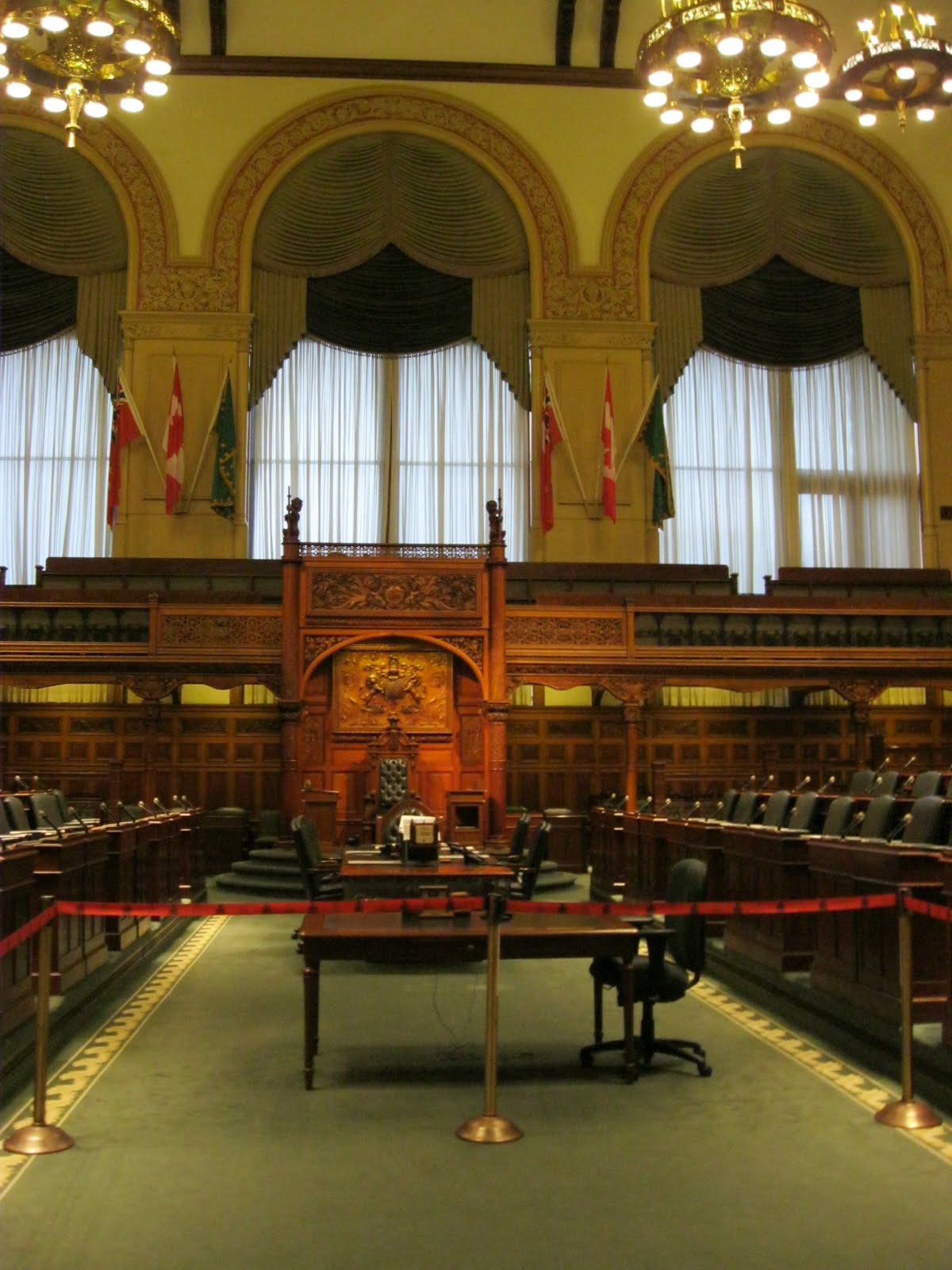 The medieval borrowings in the building and the Legislative Chamber are then really appropriate, because it is from those traditions that our modern form of government has developed. If you look around the Chamber, in addition to inheriting the parliamentary traditions, there is again a conscious use of medieval style, for instance the gargoyles and the figures of whimsy and power.
  We again have human faces carved into the Chamber, though unlike the carved political figures on the outside of the building, these ones are tributes to the artists.They are enhancing the whimsy of the space, but they are also people who will forever watch the parliament, so they are not devoid of symbolic meaning.
 By the 1200s, the times of the first real parliaments, the mace is being carried by the sergeants-at-arms who protect the king. In time it comes to stand for the authority of the monarch. All British/Commonwealth parliaments still have them. The mace conveys authority, derived from the monarch, to the parliament. Authority is given through it to the speaker, as no one is allowed to pass between the speaker and the mace while the house is in session. Authority is also given to the Members of (Provincial) Parliament, since they are not allowed to have a session without it, and since the mace still points to the Government, and specifically the leader of the government. It’s role as stand in for monarch is also preserved, because when a Vice-Regal representative or the monarch is in the Chamber the mace is, in our case, placed under the table.
 The Legislative Building houses the Ontario Art Collection. Started by founder of the Normal School, Egerton Ryerson, when he went on his ‘Grand Tour’ of Europe. The grand tour was a custom for Victorians, who would go to Europe to collect copies of masterworks. Ryerson brought the copies back to the school museum to be used as educational tools. He brought back paintings as examples of ‘culture.’ So let’s look at what Victorians thought ‘culture’ meant. The subjects of the paintings are classical and biblical, but the original works are renaissance or medieval. Culture was rooted in the past, not the present or the future. It is in this way, through the art and the architecture, that the Victorians brought the medieval into their present. This painting of St. George and the dragon is one of those copies, brought back to educate people who, living in Canada would probably never see the like otherwise.
  As was mentioned above, St. George, depicted here, who, even when divorced from religion, is symbolic for the whole English nation. St. George is known for slaying a dragon, to save a princess. He is the Victorian ideal of a medieval hero. The frame around the painting has dragons on it, indicating it was made for this painting. But St. George, again, is part of the reason why the dragons are everywhere in the building.


