View My Stats

Sunday, January 29, 2012

I for one am stoked! Tourism and History in Bruce-Grey-Simcoe

Have we snow? I offer three words. 'Wax up dudes.'


So says historical figure John Graves Simcoe in Bruce-Grey-Simcoe's new advertisement campaign, highlighting this area of Ontario's yearly winter wonderland. In the ad on the radio John Graves Simcoe is purportedly raving about the ski conditions in the county that was named after him. If you look at the advertisement campaign on the web, Sir James Bruce, 2nd Earl Charles Grey and Lt. Governor Simcoe all have something to say. An historic photo of them has had ski gear added to it, and the photo speaks. Simcoe's contribution is mentioned above. Bruce says 'Another robust winter is upon us. I for one am stoked!,' and Grey says 'I quite fancy skiing. Especially the Apres."


Many tourist sites are also historic sites. If you think of a location and you are trying to think of what there is to see there, often you think of the old structures and the museums, the sites where specific events happened. No? Just me? Well anyway, for the sites where it is less about seeing and more about doing, like skiing and theme parks and mini putt, history perhaps plays less of a role. However those kind of tourist sites often break out around historic locations, because those places have been interesting to generations of people, like Niagara Falls, or Wasaga Beach. Skiing is a little different though. The hills are not centres where people have been coming and going for centuries, like harbours, or river intersections. But it is the best place for skiing.

I thought the campaign was so interesting. First of all, people are actually going to engage with historical photos of some of Ontario's first founders. These are not people that are well-known. I am familiar with John Graves Simcoe myself, but I even have not done a lot of research about Charles Grey or James Bruce. People are still not going to know who they are, but they are at least going to realize that the county's are named after specific people. This is the most interesting kind of historical education, because it will open the door for certain people to ask more questions, and it brings that tourist approved historical significance to a tourist attraction devoid of that kind of connection or cultural significance.

How effective it will be as an advertisement campaign is harder to judge. I will certainly remember it. And it's quite clever.

Wednesday, January 18, 2012

Dragons, Romanesque and Parliament: Medievalisms at the Legislative Assembly of Ontario as expressions of power

When you stand on the edge of Queen’s Park, the site of the Ontario Legislative Assembly since 1893, you find yourself in what is the most medieval-esque looking area of the city. Medieval-esque is a frightfully vague word, but in its vagueness describes that feeling we get when we get the sense that something is inexplicably medieval. Then again, maybe its not that inexplicable.


A medievalism is a number of things. The way we think about the Middle Ages changes as we change, so even when we study the Medieval period that is a medievalism, because we have to interpret the past through our own eyes and our own version of historical events. However, it is also a medievalism when we use elements of what we think the Middle Ages were to create something new. Likewise, we can also call it a medievalism when elements have continued on from the Middle Ages and we use those elements in our own, modern way. A medievalism is anything where the Middle Ages is being interpreted and transmitted to a more modern audience.

There was no European Middle Ages that occurred geographically here in Toronto, so the medievalism we encounter all around us in the architecture at Queen’s Park is where people use symbols from the Middle Ages to create something new. We’re next to the Gothic structures of U of T, including the awe inspiring Trinity College.


Gothic and Romanesque are two quintessential Northern European Medieval Architectural styles. At Queen's Park the central figure is the massive Romanesque Revival structure. So, built in 1893, why did Canadian Victorian society decide to refer to medieval precedents when constructing their civic structures?


In the early Victorian era medieval and not classical elements are sometimes chosen in Canada to emphasize the Britishness of the cultural influence, which is in opposition to their U.S. neighbours, who want to skip Britain and go back to classical roots (see some of the conclusions reached in the project Mapping Medievalism at the Canadian Frontier). That is in play here, especially in the structures of U of T which are referencing the medieval university traditions at places like Oxford, or Cambridge with their Gothic style. But I don’t think that is the whole explanation. I think in this time, approx. 1870-1885, they use a medieval style of architecture only in part to emphasize Britishness, but mostly they see this as an appropriate symbol for power. It can’t be wholly to separate themselves from the United States because this is a uniquely American form of Romanesque.

Richard A. Waite, British-born Buffalo architect, was given the contract to design the building. This was after as a member of the selection committee he had decided that the Gothic design (the other most recognizable medieval architectural style), proposed by Darling and Curry was unsuitable. The architectural style Richardsonian Romanesque was developed by Henry Hobson Richardson , and it was perfected in New England. When they were designing the civic structures in Toronto they favoured this Richardsonian Romanesque style. E.J. Lennox designed Old City Hall in the Richardsonian Romanesque style, and R.A. Waite chose the style for these, the Ontario Parliament Buildings. These buildings are associated with power. So at that time Richardsonian Romanesque, this Medieval style tempered with American influence, was how Torontonians, as well as New Englanders, expressed power through a structure.

The carvings on the building reflect the Richardsonian Romanesque style. They are largely floral and whimsical, though there are some allegorical. For instance, the building is covered in gargoyles. Some of them look like they should be spouts,which would have been part of their function on Romanesque cathedrals, but is not their function here. They reflect the medieval tradition of the gargoyle, which adorned medieval Romanesque and gothic structures of power. Gargoyles protect the building, and keep evil from it, while at the same time they are whimsical.


The rose window with the Gothic tracing that can be seen on the southwest corner of the central structure of the building was not part of the original plan. Originally it was supposed to house a clock, but during construction they ran out of funds and so the clock was never built. The building opened in 1893 with that area boarded up. They eventually installed this round window. But the carving around the window reflects the original intent to put in a clock and reflects medieval traditions. The signs of the zodiac were placed around the circle as they were in medieval calendars. It shows a conscious effort on the part of the architect R.A. Waite and possibly chief carver William McCormack, to build a Romanesque building while referencing the Romanesque roots and time period.


A Romanesque cathedral might have figures of apostles or saints, figures which are meant to lend power to that location, and give that power spatial representation. Here it is no different. On either side of the building are important political figures who, in a very similar way, give power to the activities that go on here. These figures say that Canadian politics is represented here in this building. What they give to the abstract concept of politics is a spatial representation in this building and a sense of importance, by giving the history of Canadian politics the sense of a past of mythic and monumental proportions.


Waite wanted to use natural light, to compensate for the darkness of the heavy walls. Part of the result was the use of stained glass, a common medieval art form, which look out on to laylights. This is another medievalism that was used as a tool by Waite to increase the sense of grandeur of this building, and is in keeping with dynamic interior space which is part of Richardsonian Romanesque.


Dragons recur throughout the building, inside and out. Here are the dragons at the base of the pillars on the first floor of the east wing. In the Middle Ages the dragon represented the ‘other.’ The knight defeating the dragon was conquering the other - restoring order. In this case the placement of the dragons at the base of the pillars shows, in a similar way, the wild creatures being subdued. Likewise, the tops of those pillars, on the third floor east wing, have dragons adjacent to the ceiling, so that dragons appear on both ends of the pillars. Not to take away the element of whimsy, but in British culture the dragon has special meaning because of St. George, patron saint of England who slew a dragon, and is it is pervasive as a popular symbol in keeping with the medieval style of the building. The moral is: Victorians like dragons! But there are reasons as to why they like dragons.


For the art and architecture a medieval style was chosen, but when we look at the debts and carry-overs in the parliamentary tradition from the Middle Ages we can see why medieval symbols are appropriate to help represent a British Parliament. One carry-over from the Middle Ages is the use of standards to represent people or a group (in this case a nation). Even before the Middle Ages people would give themselves a symbol, often a symbol to rally around during battle. It was in the medieval period, however, that heraldry becomes more formalized. It might be that heraldry, flags, coats of arms, standards, developed at first because people needed to other recognize people on their side during a battle once armour began to obscure who was who, though some historians argue that it was more a fashion and individual vanity that prompted the use of such signs. At first people chose their own symbols, and eventually, when they were associated with nobility, they became hereditary.The origins of Britain's heraldry are very medieval. The British Flag is made up of the cross of St. George (England’s flag),

the cross of St. Andrew (Scotland’s flag)

and the cross of St. Patrick (Irelands’ flag).
These countries are still represented (in the British flag at least) by their respective saints, a tradition that continues on from the Middle Ages. There has also been a perceived continuity to the British monarchy since 1066. In fact, our concept of Britain, the nation, as we understand it took shape during the Middle Ages.

Ontario's Coat of Arms was established in 1909, so it is easy to tell which parts of the building are more recent additions or were reconstructed because the Coat of Arms won't appear on anything original to 1893. The Chief Herald of Canada is the one who, using elements and tropes established from the Middle Ages onwards, is able to create new Coat of Arms for new groups. Even though the Chief Herald is creating something new the Coat of Arms and heraldry is rooted in tradition, so the forms and symbols the Coat of Arms uses are fitted into pre-existing medieval patterns.


It was the signing of the Magna Carta in 1215 which made the King subject to the law and redefined where authority was derived from (that is the basic statement, since as one of the West's favourite documents it is one of the most debated, but for arguments sake lets take this classic view of it). It was signed by King John, but it was King John’s son Henry III who first referred any matter to a ‘parliament,’ meaning he is the first British monarch to also use the word ‘parliament.’ Parliament comes from the French word parlement (remember the French origins of Britain’s rulers since 1066), which is from the Latin parliamentum. Basically it means discussion. He was also the first king to ask his subjects for regular taxation, as the revenues from Crown lands were no longer enough to run the realm. Many of the first members were barons, who were asked for taxation, but eventually they had to ask for taxes directly from representatives of towns, clergy and counties. Length of sessions were based on need, and most often they met in Westminster, but they could meet anywhere. The commons emerged in the 14th century as a group distinct from the barons, but they were usually knights and burgesses. The parliament was also considered the highest court, as people could bring their issues and petitions that they would like to have answered. (For more information see the BBC's History of Parliament).


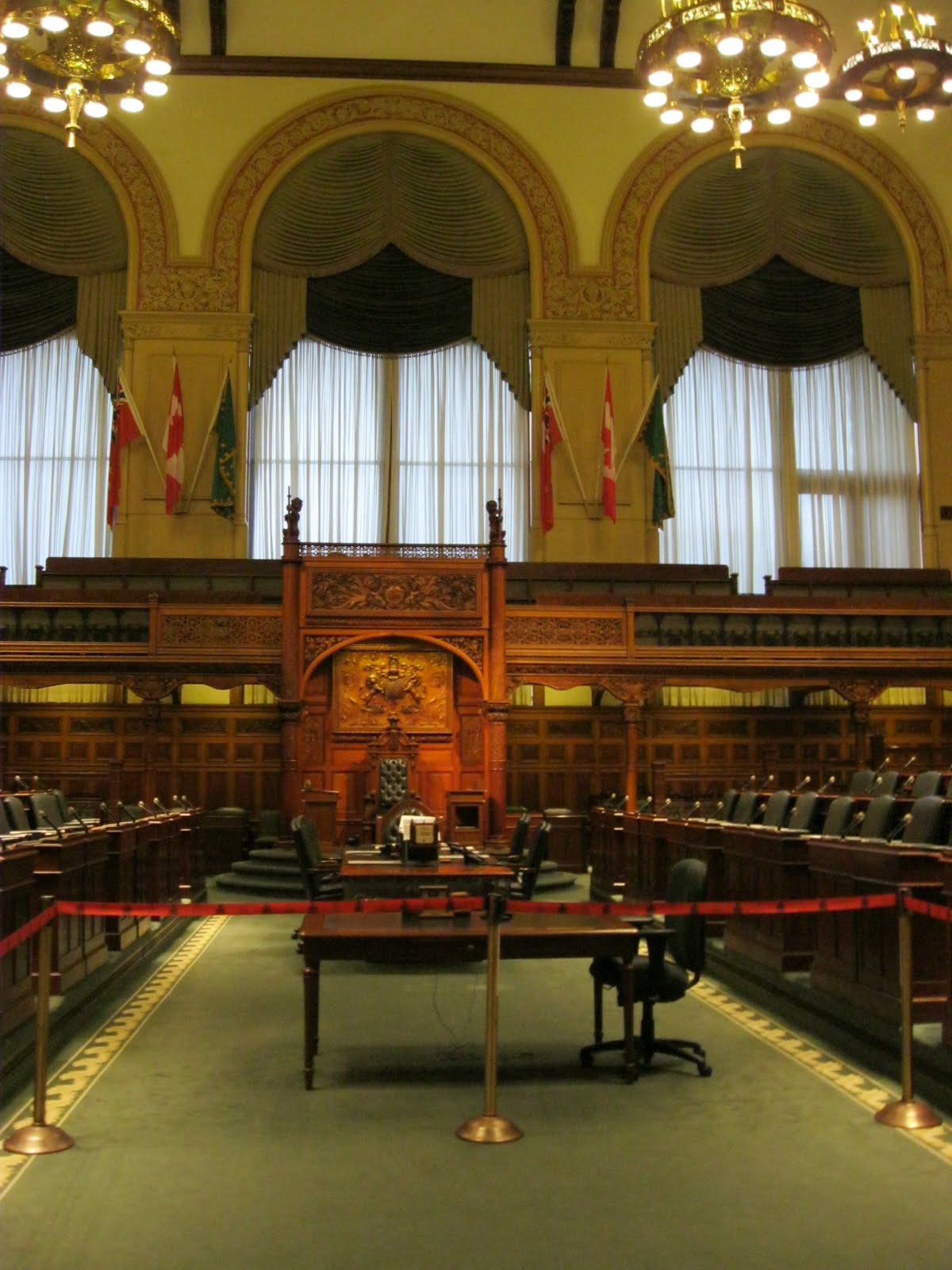
The medieval borrowings in the building and the Legislative Chamber are then really appropriate, because it is from those traditions that our modern form of government has developed. If you look around the Chamber, in addition to inheriting the parliamentary traditions, there is again a conscious use of medieval style, for instance the gargoyles and the figures of whimsy and power.


We again have human faces carved into the Chamber, though unlike the carved political figures on the outside of the building, these ones are tributes to the artists.They are enhancing the whimsy of the space, but they are also people who will forever watch the parliament, so they are not devoid of symbolic meaning.


But there are actual gargoyles around the Chamber, subdued at the base of pillars.

Finally, resting under the Clerk's table is the Legislative Mace, which is placed on the table when the House is in Session to symbolize Ontario's Parliament's authority to make it's own laws. But, as young grade fives are quick to point out, the mace starts out as a medieval weapon, carried into battle by fighting members of the clergy who are not permitted edged weapons. Its use by important people causes it to be used as a symbol of authority.
By the 1200s, the times of the first real parliaments, the mace is being carried by the sergeants-at-arms who protect the king. In time it comes to stand for the authority of the monarch. All British/Commonwealth parliaments still have them. The mace conveys authority, derived from the monarch, to the parliament. Authority is given through it to the speaker, as no one is allowed to pass between the speaker and the mace while the house is in session. Authority is also given to the Members of (Provincial) Parliament, since they are not allowed to have a session without it, and since the mace still points to the Government, and specifically the leader of the government. It’s role as stand in for monarch is also preserved, because when a Vice-Regal representative or the monarch is in the Chamber the mace is, in our case, placed under the table.

In the Chamber there are more examples of heraldry, standards derived from the Middle Ages. For instance, the Royal Coat of Arms behind the Speaker’s Chair, which includes the three lions of England, the harp of Ireland, the unicorn of Scotland on the shield, is derived from the symbols used during the Middle Ages. For instance, the three lions go back to the symbol used by Richard I and which has endured as a symbol of England.

The question is do we still perceive those symbols as something medieval? I do, but I study medieval things. Do most people just see it as tradition, from a non-descript past?


The Legislative Building houses the Ontario Art Collection. Started by founder of the Normal School, Egerton Ryerson, when he went on his ‘Grand Tour’ of Europe. The grand tour was a custom for Victorians, who would go to Europe to collect copies of masterworks. Ryerson brought the copies back to the school museum to be used as educational tools. He brought back paintings as examples of ‘culture.’ So let’s look at what Victorians thought ‘culture’ meant. The subjects of the paintings are classical and biblical, but the original works are renaissance or medieval. Culture was rooted in the past, not the present or the future. It is in this way, through the art and the architecture, that the Victorians brought the medieval into their present. This painting of St. George and the dragon is one of those copies, brought back to educate people who, living in Canada would probably never see the like otherwise. As was mentioned above, St. George, depicted here, who, even when divorced from religion, is symbolic for the whole English nation. St. George is known for slaying a dragon, to save a princess. He is the Victorian ideal of a medieval hero. The frame around the painting has dragons on it, indicating it was made for this painting. But St. George, again, is part of the reason why the dragons are everywhere in the building.

One thing that is striking is that the medievalisms at Queen’s Park, the parliament, Romanesque, dragons, the mace, all incorporate the medieval as symbols of power. The parliament is the decision making body, the grandeur of the Romanesque is seen as appropriate to be associated with sites of power, the mace confers authority on the parliament, and the dragons are both a power that has to be subdued and represent the power of Britain. So the sense that we get that we are surrounded by the medieval is because we are, though we are also well aware that this is an interpretation both by Canadian Victorian society as well as by modern society. The medieval elements we decide to use in our culture tell us a lot about how we view the medieval, but they also show how our distant medieval past influences our present.

Sunday, October 30, 2011

The PhD applicant and the modern Scandinavian language: A Battle of Wills!

One of the major obstacles standing between me and a PhD in a Scandinavian Studies Department is the lack of a modern Scandinavian language.


I don't know if I could have taken it at University while I was there. I am about 98% certain there was no opportunity while I was doing a Medieval Studies degree at Queen's University in Kingston, though I did take Old Norse and Anglo Saxon. If I did have an opportunity it would probably have been during my MA in Norse/Viking Studies in Nottingham. But in my defense, I neither saw anything about it, nor at the time did I realize how much I was going to need one. I actually had the same problem with German, didn't quite realize how necessary it was, but the fix for that has been very easy. At the University of Western Ontario I took German in a class, but if I wanted to do some night school in German here in Toronto somewhere it would be quite easy.

Now, a modern Scandinavian language however, no such luck. No schools in Toronto offer any such thing. Spanish, sure. Greek, no problem. But Swedish? Nah! But to do a PhD in the departments that are most likely to have supervisors for my work, a.k.a. Scandinavian Studies departments, I need it. Right now the schools that I am particularly looking at are the University of Wisconsin-Madison and UCLA Berkeley. This is why it has become a Battle of Wills: my determination to do whatever it takes to get in. When it comes to my PhD, to quote the immortal Wayne's World, 'it will be mine. Oh yes, it will be mine.'

So this is the result of my research:


I have decided to start by learning Swedish. This choice is in part because, as my two specialties are Norse history and Public History eventually I am going to want to look at how movies portray Norse history. Then I should pick the language of the most robust film industry in Scandinavia. But I was on the fence with Swedish and Norwegian. It was the excellent website, and program, of the Uppsala International Summer Session that put me over the edge. Their intensive program, with easy to understand website and application process, put me over the edge. Since making the decision to go there I have also spoken with at least two other people who have gone there, making me feel more confident in this choice. So the plan is to peruse the Swedish grammar over the next six months, so that I do not have to enter the beginner-beginner program. I will probably sign up for Babbel, or try the University of Stockholm's free exercises. I will also probably get a starter grammar book and work through the exercises and vocabulary. Then I will do the course in Uppsala in the summer (hopefully with the aid of a scholarship, because otherwise it may be more of a problem.)

But in my research I came across several options for people trying to study Scandinavian languages in Canada/North America.

Swedish

As I say, this is the language I have chosen, the language of Ingmar Bergman, the place of many runestones. I have chosen to study in Sweden because of the value this would be to admissions boards, and because there is no better way to learn a language than by immersion. Trust me. I studied French since I was 8, but it wasn't until I spent three months with a Francophone family that I could actually speak the language. But you can also learn from a local institution (though, as I have said this is not everywhere available), or you can learn online.

An excellent summary of options for learning Swedish is provided by Study in Sweden. If you choose to study online, for admissions purposes a paid course is better, as there will be evaluation. However, they cost just as much or more than regular university courses. Folkuniversitet looks like it may be the best. It ends up to be about $860(Canadian) a module. Because I want to study in Sweden, this is why I do not wish to pay for other courses.

Norwegian

I was also thinking about studying Norwegian, because I actually hope to do my dissertation on the King's Sagas. More specifically Harold the Hardruler, who was king of, well, Norway. So in many ways it makes sense, particularly for studying the historiography. However, I will still study this, just in an informal setting. The reasons I did not chose Norwegian is because they had no equivalent classes like that offered at Uppsala. The closest I found was the International Summer School at the University of Oslo, which does still seem to offer a lot for those interested in learning Norwegian in Norway. For a summary of how to learn Norwegian a list of options is provided by this Study in Norway website, which is not quite as comprehensive as the Study in Sweden equivalent.

Danish

Danish is an excellent option because, of course, politically speaking it was dominant for so long that many of the historiographical works from throughout Scandinavia are written in Danish. The University of Copenhagen has courses for students, but it is not obvious whether the classes are Danish. A list of other options is provided on the Danish consulate in New York's website. Those are paces that teach Danish in Denmark. Here is another list, from Work in Denmark that give options for learning Danish. I did less research here, as this was less interesting to me, so there may be a more comprehensive website, but as of now I am yet to find it.

Icelandic

It may be erroneous to say so, but from what I understand Icelanders read Old Norse like we read Chaucer. You can kind of read it. You have to have an open mind for interpretation, but it is possible. Therefore this, you would think, would be really useful for a student of Norse and Viking Studies. But be careful, because some of the Departments require a 'mainland' Scandinavian language. The University Centre of the Westfjords offers Icelandic courses, so it is already up on Denmark on having language courses easy to find over the web. Likewise, there are many online options. I am yet to discover a comprehensive list of ways to learn modern Icelandic, like there are for the other countries, but it may yet be out there.

Finnish

Um, there are many good things to say about Finnish, but if you are a student of Norse/Viking Studies you are barking up the wrong tree. The other languages are in a similar linguistic group. Finnish has so many - was it cases, or maybe it was tenses - that it has been called one of the hardest languages to learn. It is closest to Hungarian, as opposed to anything else. And the history is rich, but different. I did no research here. I say go up and read one of the other languages I looked into.

So good luck to all PhD applicants out there, or people interested in Scandinavia. Hopefully your determination too will win out.

Sunday, August 14, 2011

History in the City for the young and the young at heart


So, you've done Centre Island and they've been to Canada's Wonderland. You went to the zoo and they spent the day at the beach. Now what? And why was any sort of museum programming the last thing you thought of? Don't worry, it's not just for the nerdy children amongst us. Often they have so much fun they don't realize they're learning something. Or they don't learn anything, which is fine too, because you might, and they would learn the same nothing at Canada's Wonderland and they'll still have fun.

Studies often show that most of us did not retain the history we do know from what we were taught in school. Many of us remember snippets of movies, books or, mostly, the museums we visited as children. And don't worry if you don't remember what the population of Toronto was when it was founded in 1834, if you remembered that it's only really been around for less than two hundred years, or even if you got the sense that the city was kinda old you did take something away from the experience, whether you meant to or not.

I loved going to museums when I was little (surprise, surprise). Living history museums shaped a large part of the trajectory of my life. I felt like I was stepping into a story. That interested my sister less, but she always liked things like art and making things, and there was always something interesting for everyone to do.

So if you live in the city and are wondering what to do with these last dog days of summer, here are some of the programs aimed at children being put on until the end of August at Toronto Heritage Institutions (which I think includes things like Halls of Fame, Art Galleries and Science Centres, but that is a debate for another day):


Colborne Lodge


Colborne Lodge
has Pay What you Can Sundays. Go and see what you can of the house of High Park founders John and Jemima Howard. And while you're at it, spend the day in the park.
Hours: Tuesday - Sunday noon-5 p.m.
Admission: Adults: $5.71
Seniors (65 +): $2.62
Youth (13-18 yrs.): $2.62
Children (4-12 yrs.): $2.38

Fort York

Fort York has special programming going on all summer. See the cannons fire at 12:30, see the fife and drums in the afternoons, and enjoy the hourly drill demonstrations. This one of the larger living history museums in the city, and certainly represents the oldest time period for Toronto (Fort York was founded when this area was made Upper Canada's capital, around 1796).
Hours: 10 a.m. - 5 p.m.
Admission: Adults: $7.62
Seniors (65 +): $3.81
Youth (13-18 yrs.): $3.81
Children: (4-12 yrs.): $2.86

Gibson House

The Gibson House has a special tour on Sundays, noon to 5 pm, of their 1850s kitchen. This includes a taste of what's cooking and, of course, the hands-on children's activities available in the Discovery Gallery.
Hours: Tuesday - Sunday, noon - 5 p.m.
Admission Adults: $5.48
Seniors (65 +): $3.10
Youth (13-18 yrs.): $3.10
Children (2-12 yrs.): $2.62

Mackenzie House

Mackenzie House, home of Toronto's first mayor has kids crafts on Saturdays and Sundays from noon to 4:30.
Hours: Tuesday - Sunday, noon - 5 p.m.
Admission: Adults: $5.71
Seniors (65 +): $3.81
Youth (13-18 yrs.): 3.81
Children (5-12 yrs.): $3.33
Children (4 and under): Free

Scarborough Museum

The Scarborough Museum has special activities for adults and kids every Saturday and Sunday for their Summer Victorian Extravaganzas. Shows, music, merriment; experience early life in Scarborough.
Hours: Tuesday - Sunday, noon - 5 p.m.
Admission: Donation


Legislative Assembly of Ontario


The Legislative Assembly of Ontario, perhaps not one of the first places we think of when we think of history, but has been there since 1893 and is one of the rare historic buildings that is still in use today. Wednesdays at 10:30 a.m. until the end of the summer there is a scavenger hunt on the grounds, aimed at children between the ages of 6-12. Pre-register or drop in.
Hours: 9:00-5:00
Admission: Free

Royal Ontario Museum

At the Royal Ontario Museum the ongoing exhibit Water includes many hands-on activities and panels aimed at kids. This is in addition to their usual galleries, where the natural history (dinosaurs, bugs, birds and the like) is usually a big hit.
Hours: Saturday - Thursday 10 a.m. - 5:30 p.m., Friday 10 a.m. - 8:30 p.m.
Admission:Adult: $24 + exhibit $31 ($24 + $7)
Senior (65+ years): $21 + exhibit $28 ($21 + $7)
Student (15 to 17 years): $21 + exhibit $28 ($21 + $7)
Child (4 to 14 years): $16 + exhibit $19.50 ($16 + $3.50)
Infant (3 years & under) Free

Bata Shoe Museum

At the Bata Shoe Museum host Weekend Family Fun every weekend, save for when they have other big events. There they can try on shoes, paint a clog or go on a treasure hunt in the galleries. This too is in addition to their usual hands-on exhibits.
Hours:Monday, Tuesday, Wednesday, Friday, Saturday: 10:00am – 5:00pm
Thursday: 10:00am – 8:00pm
Sunday : 12:00pm – 5:00pm
Admission:Adults: $14
Senior citizens (65+): $12
Students (with ID): $8
Children (5-17 years inclusive): $5
children under 5 are free

Gardiner Museum of Ceramic Art

At the Gardiner Museum of Ceramic Art every Sunday is family day. The first Sunday of a month is a movie and a themed scavenger hunt. The second Sunday is themed paper crafts in the lobby. The third Sunday is the guided kids tour and on the fourth Sunday of the month there is typically a performance by storytellers, musicians and other entertainers, though this month the last Sunday will be more crafts in the lobby.
Hours: Monday to Thursday: 10 am – 6 pm
Friday:10 am - 8 pm
Saturday & Sunday: 10 am – 5 pm
Admission:Adults: $12
Seniors: $8
Students: $6
Children: FREE (under 5)


Black Creek Pioneer Village


At Black Creek Pioneer Village, another living history museum, everyday at 2:00 they have a demonstration of something, perhaps butter churning, harness making or something else. They also have daily animal programs, as well as a hands-on history centre. Collect an historic passport and get it stamped at five of the different historic buildings once you complete a task or explore a Country Kids Trail. All these activities are available all summer.
Hours: Week days: 10:00 a.m. - 5:00 p.m.
Weekends: 11:00 a.m. - 5:00 p.m.
Admission: Adult (Age 16-59): $15.00
Child (Age 5-15): $11.00
Infant (Age 4 and under): Free - does not apply for group bookings
Senior (60+): $14.00
Student (16+): $14.00

Ontario Science Centre

At the Ontario Science Centre join them for KidSpark, an activity happening each weekday at 11:00 in July and August. It could be a number of things, including a science demonstration or an art project.
Hours:10 am - 6 pm
Admission:Adult (18-64): $20
Child (4-12): $13
Youth (13-17), Student (with ID), Senior (65+): $16
Infant (3 & under): Free!

Canadian Air and Space Museum

The Canadian Air and Space Museum has a Future Pilots program running on August 20-21. This is a hands on full day activity for teens.
Hours:Wednesday, 10:00am - 8:00pm
Thursday - Saturday, 10:00am - 4:00pm
Sunday, 10:00am - 4:00pm
Holiday Mondays, 10:00am - 4:00pm
Admission: Adults 18+: $ 11.00
Seniors 60+: $ 9.00
Students with school ID: $ 9.00
Military with ID:$ 9.00
Children 5 & under: FREE
Family: 2 adults & 2 Students: $ 27.00


And don't forget the other museums etc. around the city:

Art Gallery of Ontario

The Hockey Hall of Fame
Historic Zion Schoolhouse
Montgomery's Inn
Spadina House: Historic House and Gardens
Todmorden Hills Heritage Site
York Museum
Museum of Contemporary Canadian Art

For more information of upcoming events check out Toronto Museum Events, or the ROM, AGO, Hockey Hall of Fame, Black Creek Pioneer Village etc. websites.

SNL, Pop Culture and Popular Medieval Misconceptions

Read my new blog post on the Society for the Public Understanding of the Middle Ages blog .

In it I muse on how when someone says Viking funeral, the image that is recalled is of a burning ship. No one really cares whether or not this is an accurate tradition, because while the people who are saying are only cursorily meaning to refer to the Middle Ages. What they mean to refer to is the pre-existing cultural image of something going up in flames. It is more interesting to medievalists than anyone else the process of how it got from the historical act of burying their dead to the current twentieth/twenty first century idea of a 'Viking' burial.

Sunday, July 10, 2011

Review of Mapping Medievalism

Prof. Richard Utz, in the blog medievally speaking, gives the Mapping Medievalism at the Canadian Frontier project a wonderfully glowing review, commenting on both the originality of the project as well as its place in the academic world of medievalism.

medievally speaking: Brush, ed., Mapping Medievalism at the Canadian Frontier: "Kathryn Brush, ed., Mapping Medievalism at the Canadian Frontier . London, ON: Museum London & McIntosh Gallery, 2010. Reviewed by Richard Utz."

Sunday, June 19, 2011

The 44th and 46th International Congress of Medieval Studies

This is the first year that I presented at the International Congress of Medieval Studies, which you can tell if you look at an earlier post, but it is not the first time I have ever attended.

44th International Congress of Medieval Studies


One of my favourite stories to tell is my trip to the 44th International Congress of Medieval Studies. I had asked my friend to go with me. She is not a medievalist per se, but she is interested in all things historical and I knew that if I could drag anyone to come with me, it would be her. She is not, how shall we say, the most organized of people to ever grace this planet. For the purposes of the story I will call her K.

I had personally helped K to fill out a passport application, as hers was expired, but day of she still didn't have it. So the day when we are supposed to leave we head over to the passport office, and it seems that it's never been processed because for some reason her fee has not been processed. So, no chance there. This is before they got stringent however, and we decided we would try to cross anyway. I proposed, instead of driving to Windsor from Toronto and crossing right into Michigan (the location of the conference) that we would go the shorter distance, to Niagara on the Lake, and cross into New York and go under the lake. Longer in the long run, but shorter if I needed to drive her back to Toronto. On the way down we did a bit of obsessing, and I mentioned, as a joke, that we could hide her in the trunk. She looked at me a little cock eyed, and I had to explain how we weren't actually going to do that. Good thing to, because once we got there, since we were going somewhere academic (probably also because we were young females) and because she had her old passport and health card, they let us across. They did, however, take a scan of the car. Bullet officially dodged.

We got to the other side, and had a lot more driving to do than we otherwise would have, but were basically kissing the American soil.

The 46th International Congress of Medieval Studies


If you want to make one of the border crossing officers actually smile tell them you are going to the International Congress of Medieval Studies. Don't, however, tell them about your paper, as they are amused and not necessarily interested.

I drove up on Thursday evening, and missed Wednesday and Thursday's sessions, but here are the sessions I did attend:

Friday


10:00 am
Session 199
Old Norse Literature and Culture - organized by Paul Acker, St. Louis Univ.

Warriors and Wild Beasts in the Heroic Poems of the Elder Edda
- Richard North, Univ. College, Univ. of London

This was the only presenter for this panel, the others had cancelled. It as a very convincing argument about the connection between wolves, bears and warriors. The premise was that when the warrior goes into battle he takes onthe qualities of an animal. Usually, as well, if they are a bear that is good and wolves are bad.

1:30 pm
Session 262
Twenty-First Century Medievalisms - presider Julie Nelson Couch, Texas Tech Univ.

"The Darkness of the Womb": Allegory and Early Medieval Historiography in S.M. Stirling's Emberverse
- Alicia McKenzie, Wilfred Laurier Univ.
This paper examined how the author not only interprets medieval society, but also how the author interprets medieval historiography and his rejection of the very rigid 'medieval' structure in favour of a fluid and adaptable one.

Rexiles: A Re-envisionist History of the Kings of Britain
-Aaron Long, American Univ.
Unfortunately I do not remember much about this paper.

What is the Impact of Popular 'Medieval Films' on the Public's Understanding of the Middle Ages? A Sociological Approach
- Paul B. Sturtevant, Univ. of Leeds
This looked at the impact of medieval film on popular understanding of the Middle Ages by conducting focus groups to talk about it with members of the public.

Concerning the Newfound Popularity of Lionheart's Acre Massacre in Video Game Narratives
- Carl S. Pyrdum, III, Yale Univ.
This paper was about the appearance of the massacre of Acre in video games. He traced the popularity of the event to it's appearance in Assassin's Creed, and compared it to it's appearance in Dante's Inferno. The conclusion was that while Dante's Inferno is less well done for a video game, it almost had a better treatment of the massacre because it was dealing better with the actual event, and the political correctness of Assassin's Creed limited their interaction with the event.


Saturday


10:00 am
Session 369
Old Norse Literature - presider Jana K. Schulman, Western Michigan Univ.

Out of Silence, Vision: Helga's Gazing in Gunnlaug's saga
- Molly Jacobs, Univ. of California-Berkeley (Graduate Student Prize Winner)
This was a very interesting paper about how Helga's gaze actually makes her an active participant, as opposed to a passive character.

1:30 pm
Session 437
Nineteenth Century Medievalisms - organized by Richard Utz, Western Michigan Univ.

A Tale of Two Medievalisms: Muscular Christianity and the Tour de France
- Christine M. Havens, Hawkeye Community College
This paper argued that the Tour de France celebrates a tradition of masculine and muscular christianity, and uses medieval imagery to celebrate this. And there were so many parallels, including a disgraced hero named Lance.

Recovering a Not so Imaginary Past: Medievalism in Scott's Harold the Dauntless
- Renee Ward, Wilfred Laurier Univ.
This paper talked about the medievalism of Sir Walter Scott in one of his least loved works.

Ancient Mysteries: A Regency Printer Uncovers the Medieval
- Clare A. Simmons Ohio State Univ.
Unfortunately, Ido not really remember what this was about.

Transatlantic Medievalisms: Julian of Norwich's XVI Revelations in the East End and Harvard in the 'Hungry 40s'
- Vickie Larsen, Univ of Michigan-Flint
This looked at one nineteenth century translator's Julian of Norwich and the way that his era affected his work.

3:30 pm
Session 478
Twenty-First Century Medievalism: Re-envisioning the Medieval in the Contemporary World (A Roundtable) - organizer Michael A. Toregrossa, Vistual Society for the Study of Popular Culture and the Middle Ages

Siegfried the Volk-Sung: Examining the Interpretations of Siegfried the Dragon-Slayer and the Making of a National History
- Peter H. Johnsson San Francisco State Univ.
This was a paper examining how this saga is used to make a national history in several different nations and how it is used in current popular culture.

Analysis of Arthurian Film Reviews
-Laurie Rizzo, Univ. of Delaware
This was a paper that really stuck with me, about how many couch their criticisms of King Arthur films in terms of their 'inaccuracy.'

Beowulf in the Twenty-First Century
- Suanna H. Davis, Houston Community College: Central
This paper was about the use of Beowulf in Science Fiction and how it is used to give layers to narrative, as a sort of specialized knowledge, where the authors assume we already have this knowledge.

Sunday

8:30am
Session 528
The Central Issue: What does the Public Actually Think about the Middle Ages? - organized by Paul B. Sturtevant, Univ. of Leeds

The Perceptions of Medieval Heritage among Modern Master Falconers
- Leslie Jacoby, San Jose State Univ.
This paper was about how faloners themselves see their art in relation to medieval falconry.

'Viking' North America: The North American Public's Understanding of Its Norse Heritage
- Megan Arnott, Univ. of Western Ontario

My paper!

10:30 am
Session 569
Saga Studies - presider Andrew M. Prefenger, Kent State Univ. - Salem

On the Paroemial Delineation of Character in Grettis saga
- Richard Harris, Univ. of Saskatchewan
A very interesting discussion of how literarily character is created.

Sisterhood and Female Friendship in the Islendingasogur
- Natalie Van Deusen, Univ. of Wisconsin Madison
A good paper that came to the conclusion that friendship amongst females did not really exist in the same way as it did amongst men. Men had friends and women had relatives.


I did not go to the dance. Not because I'm against dances, but mostly because I both went by myself and was presenting at 8:30 the next morning.

One of the best things about this particular congress was that I had the chance to talk one on one with so many professors in this field. I met with Profs. Acker, Schulman, Falk, Mellor and Hill and had a chance to talk about grad school in Norse studies in North America.

I look forward to my next congress. Thanks to everyone who came up to me and said they enjoyed my talk, and especially to Paul Sturtevant for organizing both the Society for the Public Understanding of the Middle Ages and for organizing the session.